


Page 464 - MARSIUM'21 COMP OF PAPER
P. 464
Muhamad Rifqi Zafran Bin Abdul Hakim (2022)
                   4.3   Normality Analysis

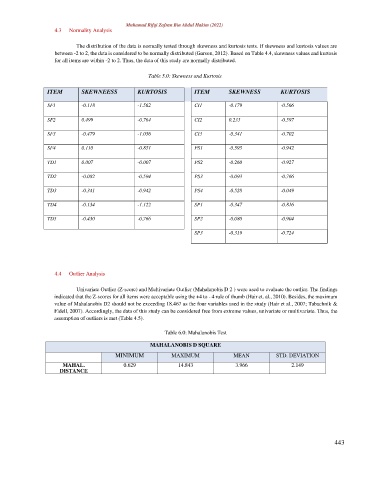
                          The distribution of the data is normally tested through skewness and kurtosis tests. If skewness and kurtosis values are
                   between -2 to 2, the data is considered to be normally distributed (Garson, 2012). Based on Table 4.4, skewness values and kurtosis
                   for all items are within -2 to 2. Thus, the data of this study are normally distributed.

                                                  Table 5.0: Skewness and Kurtosis

                 ITEM       SKEWNEESS          KURTOSIS          ITEM        SKEWNESS         KURTOSIS

                 SF1        -0.118             -1.562            CI1         -0.179           -0.566

                 SF2        0.499              -0.764            CI2         0.233            -0.597

                 SF3        -0.479             -1.056            CI3         -0.341           -0.702

                 SF4        0.110              -0.851            PS1         -0.595           -0.942

                 TD1        0.007              -0.007            PS2         -0.260           -0.927

                 TD2        -0.082             -0.594            PS3         -0.093           -0.766

                 TD3        -0.341             -0.942            PS4         -0.528           -0.049

                 TD4        -0.134             -1.122            SP1         -0.347           -0.816
                 TD5        -0.430             -0.766            SP2         -0.080           -0.904

                                                                 SP3         -0.319           -0.724


                   4.4   Outlier Analysis

                          Univariate Outlier (Z-score) and Multivariate Outlier (Mahalanobis D 2 ) were used to evaluate the outlier. The findings
                   indicated that the Z-scores for all items were acceptable using the +4 to - 4 rule of thumb (Hair et. al., 2010). Besides, the maximum
                   value of Mahalanobis D2 should not be exceeding 18.467 as the four variables used in the study (Hair et al., 2007; Tabachnik &
                   Fidell, 2007). Accordingly, the data of this study can be considered free from extreme values, univariate or multivariate. Thus, the
                   assumption of outliers is met (Table 4.5).

                                                        Table 6.0: Mahalanobis Test

                                                   MAHALANOBIS D SQUARE

                                       MINIMUM            MAXIMUM             MEAN          STD. DEVIATION
                      MAHAL.              0.629             14.843             3.966              2.149
                     DISTANCE


                                                                                                                443

