


Page 475 - MARSIUM'21 COMP OF PAPER
P. 475
Muhamad Rifqi Zafran Bin Abdul Hakim (2022)
                Saha (2005) reported that security and privacy had a strong influence on customers’ satisfaction. Based on the above discussion, the
                following hypothesis was proposed:

                          H4: Online shopping experiences has significant positive influence towards customer satisfaction

                   2.4   Research Framework Model
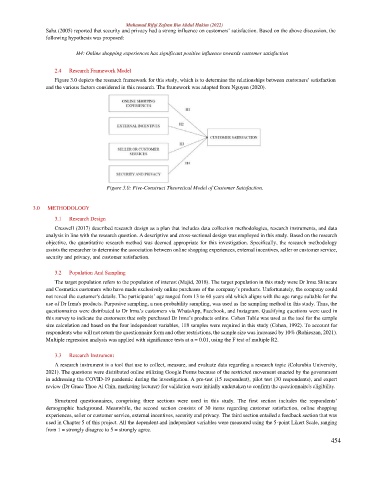
                   Figure 3.0 depicts the research framework for this study, which is to determine the relationships between customers’ satisfaction
                and the various factors considered in this research. The framework was adapted from Nguyen (2020).


                                    Figure 3.0: Five-Construct Theoretical Model of Customer Satisfaction.


            3.0   METHODOLOGY
                   3.1   Research Design
                   Creswell (2017) described research design as a plan that includes data collection methodologies, research instruments, and data
                analysis in line with the research question. A descriptive and cross-sectional design was employed in this study. Based on the research
                objective, the quantitative research method was deemed appropriate for this investigation. Specifically, the research methodology
                assists the researcher to determine the association between online shopping experiences, external incentives, seller or customer service,
                security and privacy, and customer satisfaction.

                   3.2   Population And Sampling
                   The target population refers to the population of interest (Majid, 2018). The target population in this study were Dr Irma Skincare
                and Cosmetics customers who have made exclusively online purchases of the company’s products. Unfortunately, the company could
                not reveal the customer's details. The participants’ age ranged from 13 to 60 years old which aligns with the age range suitable for the
                use of Dr Irma's products. Purposive sampling, a non-probability sampling, was used as the sampling method in this study. Thus, the
                questionnaires were distributed to Dr Irma’s customers via WhatsApp, Facebook, and Instagram. Qualifying questions were used in
                this survey to indicate the customers that only purchased Dr Irma’s products online. Cohen Table was used as the tool for the sample
                size calculation and based on the four independent variables, 118 samples were required in this study (Cohen, 1992). To account for
                respondents who will not return the questionnaire form and other restrictions, the sample size was increased by 10% (Rohieszan, 2021).
                Multiple regression analysis was applied with significance tests at α = 0.01, using the F test of multiple R2.

                   3.3   Research Instrument
                   A research instrument is a tool that use to collect, measure, and evaluate data regarding a research topic (Columbia University,
                2021). The questions were distributed online utilizing Google Forms because of the restricted movement enacted by the government
                in addressing the COVID-19 pandemic during the investigation. A pre-test (15 respondent), pilot test (30 respondents), and expert
                review (Dr Grace Thoo Ai Chin, marketing lecturer) for validation were initially undertaken to confirm the questionnaire's eligibility.

                   Structured  questionnaires,  comprising  three  sections  were  used  in  this  study.  The  first  section  includes  the  respondents’
                demographic  background.  Meanwhile,  the  second  section  consists  of  30  items  regarding  customer  satisfaction,  online  shopping
                experiences, seller or customer service, external incentives, security and privacy. The third section entailed a feedback section that was
                used in Chapter 5 of this project. All the dependent and independent variables were measured using the 5-point Likert Scale, ranging
                from 1 = strongly disagree to 5 = strongly agree.

                                                                                                               454

