


Page 502 - MARSIUM'21 COMP OF PAPER
P. 502
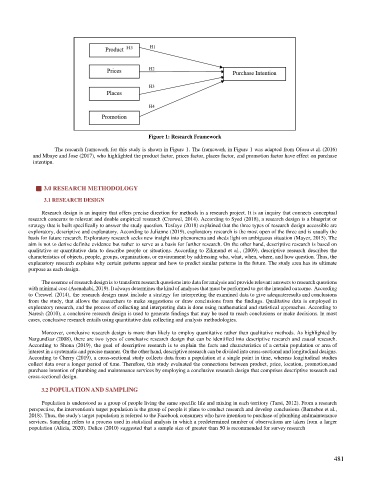
Figure 1: Research Framework

                   The research framework for this study is shown in Figure 1. The framework in Figure 1 was adapted from Ofosu et al. (2016)
            and Mbaye and Jose (2017), who highlighted the product factor, prices factor, places factor, and promotion factor have effect on purchase
            intentipn.


             ⬛ 3.0 RESEARCH METHODOLOGY

                3.1 RESEARCH DESIGN

               Research design is an inquiry that offers precise direction for methods in a research project. It is an inquiry that connects conceptual
          research concerns to relevant and doable empirical research (Creswel, 2014). According to Syed (2018), a research design is a blueprint or
          strategy that is built specifically to answer the study question. Tesfaye (2018) explained that the three types of research design accessible are
          exploratory, descriptive and explanatory. According to Julianne (2019), exploratory research is the most open of the three and is usually the
          basis for future research. Exploratory research seeks new insight into phenomena and sheds light on ambiguous situation (Mayer, 2015). The
          aim is not to derive definite evidence but rather to serve as a basis for further research. On the other hand, descriptive research is based on
          qualitative  or quantitative  data  to  describe people  or  situations.  According  to  Zikmund  et  al.,  (2009), descriptive  research  describes  the
          characteristics of objects, people, groups, organizations, or environment by addressing who, what, when, where, and how question. Thus, the
          explanatory research explains why certain patterns appear and how to predict similar patterns in the future. The study area has its ultimate
          purpose as each design.

               The essence of research design is to transform research questions into data for analysis and provide relevant answers to research questions
          with minimal cost (Asenahabi, 2019). It always determines the kind of analyses that must be performed to get the intended outcome. According
          to  Creswel (2014), the  research design must include a strategy for interpreting the examined data to give adequate results and conclusions
          from the study, that  allows the researchers to make suggestions or draw conclusions from the findings. Qualitative data is employed in
          exploratory research, and the process of collecting and interpreting data is done using mathematical and statistical approaches. According to
          Naresh (2010), a conclusive research design is used to generate findings that may be used to reach conclusions or make decisions. In most
          cases, conclusive research entails using quantitative data collecting and analysis methodologies.

               Moreover, conclusive research design is more than likely to employ quantitative rather than qualitative methods. As highlighted by
          Nargundkar (2008), there are two types of conclusive research design that can be identified into descriptive research and causal research.
          According  to  Shona  (2019),  the  goal  of  descriptive  research  is  to  explain  the  facts  and characteristics of a certain population or area of
          interest in a systematic and precise manner. On the other hand, descriptive research can be divided into cross-sectional and longitudinal designs.
          According to Cherry (2019), a cross-sectional study collects data from a population at a single point in time, whereas longitudinal studies
          collect data over a longer period of time. Therefore, this study evaluated the connections between product, price, location,  promotion, and
          purchase intention of plumbing and maintenance services by employing a conclusive research design that comprises descriptive research and
          cross-sectional design.

               3.2 POPULATION AND SAMPLING

               Population is understood as a group of people living the same specific life and mixing in each territory (Tarsi, 2012). From a research
           perspective, the intervention's target population is the group of people it plans to conduct research and develop conclusions (Barnsbee et al.,
           2018). Thus, the study's target population is referred to the Facebook consumers who have intention to purchase of plumbing and maintenance
           services. Sampling refers to a process used in statistical analysis in which a predetermined number of observations are taken from  a  larger
           population (Alicia, 2020). Delice (2010) suggested that a sample size of greater than 50 is recommended for survey research


                                                                                                                481

