


Page 505 - MARSIUM'21 COMP OF PAPER
P. 505
third-highest value of mean is the price (3.83). On the other hand, there are two variables with the lowest means value: promotion (3.73) and
            place (3.63). Meanwhile, for the standard deviation, the highest dispersion was attained by promotion which is 1.14. This is followed by
            place (0.73), price (0.72), purchase intention (0.70), and product (0.63).

                  4.4  NORMALITY TEST

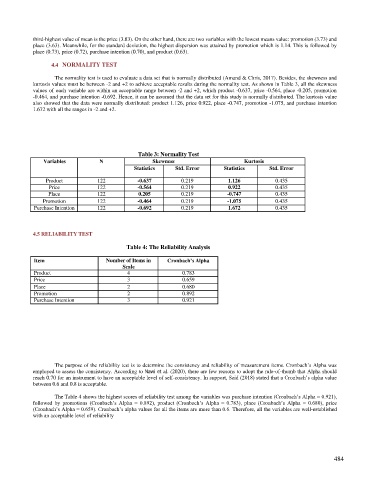
                   The normality test is used to evaluate a data set that is normally distributed (Amand & Chris, 2017). Besides, the skewness and
            kurtosis values must be between -2 and +2 to achieve acceptable results during the normality test. As shown in Table 3, all the skewness
            values  of  each  variable  are within an acceptable range between -2 and +2, which product -0.637, price -0.564, place -0.205, promotion
            -0.464, and purchase intention -0.692. Hence, it can be assumed that the data set for this study is normally distributed. The kurtosis value
            also showed that the data were normally distributed: product 1.126, price 0.922, place -0.747, promotion -1.075, and purchase intention
            1.672 with all the ranges in -2 and +2.


                                               Table 3: Normality Test
               Variables          N                Skewness                       Kurtosis
                                             Statistics    Std. Error      Statistics     Std. Error

                Product          122           -0.637        0.219           1.126          0.435
                 Price           122           -0.564        0.219           0.922          0.435
                 Place           122           0.205         0.219          -0.747          0.435
               Promotion         122           -0.464        0.219          -1.075          0.435
            Purchase Intention   122           -0.692        0.219           1.672          0.435


            4.5 RELIABILITY TEST

                                           Table 4: The Reliability Analysis

            Item                    Number of Items in   Cronbach’s Alpha
                                          Scale
            Product                        4                 0.783
            Price                          3                 0.659
            Place                          2                 0.680
            Promotion                      2                 0.892
            Purchase Intention             3                 0.921


                   The purpose of the reliability test is to determine the consistency and reliability of measurement items. Cronbach’s Alpha was
            employed to assess the consistency. According to Nawi et al. (2020), there are few reasons to adopt the rule-of-thumb that Alpha should
            reach 0.70 for an instrument to have an acceptable level of self-consistency. In support, Said (2018) stated that a Cronbach’s alpha value
            between 0.6 and 0.8 is acceptable.

                   The Table 4 shows the highest scores of reliability test among the variables was purchase intention (Cronbach’s Alpha = 0.921),
            followed  by  promotions  (Cronbach’s  Alpha  =  0.892),  product  (Cronbach’s  Alpha  =  0.783),  place  (Cronbach’s  Alpha  =  0.680),  price
            (Cronbach’s Alpha = 0.659). Cronbach’s alpha values for all the items are more than 0.6. Therefore, all the variables are well-established
            with an acceptable level of reliability


                                                                                                                484

