


Page 503 - MARSIUM'21 COMP OF PAPER
P. 503
and is regarded as an appropriate level while doing research. According to Mumtaz et al. (2020), a carefully selected small sample 100 and
           above is more meaningful than a blindly selected large sample 300 and above. Therefore, the study uses a sample size of 122. Furthermore,
           the non-probability sampling methodology was used, where judgmental sampling method aimed to collect data from Facebook consumers who
           had intention to purchase of plumbing and maintenance services, as well as they had a retail store, residential home, restaurant and grocery,
           public and private institution, warehouse, office, and hotel that require plumbing and maintenance services.

               3.3 RESEARCH INSTRUMENT

                   This study adopted the quantitative methods using a questionnaire survey tool to collect the primary data of online respondents in
           a Google form format. The questionnaire includes 6 sections, specifically Section A (demographic profile), Section B (product), Section C
           (price), Section D (place), Section E (promotion), and Section F (purchase intention). Part A contains ten questions about the demographic
           characteristics of the interviewee, such as age, gender, country of origin, occupation, and income level. In Parts B, C, D, and E, 11 questions
           related to respondents’ views on possible factors affecting the 4P of the marketing mix; product, price, location, and promotion. The other four
           questions in Part F are the customer’s intention to purchase related services.

           These items are taken over and adapted from existing tools that measure product, price, location, advertising, and purchase intention (Saaty
           & Ansari, 2011). The objective of this measure is to investigate the impact of 4P marketing mix on consumers’ purchasing intentions. The 5-
           point Likert scale was used in Part B of the questionnaire, ranging from 1 (strongly disagree, 2 (disagree), 3 (neutral), 4 (agree), and 5 (strongly
           agree) using Statistical Package for the Social Science (SPPSS) for processing and analysis information.
             ⬛ 4.0 DATA ANALYSIS AND RESULTS

            4.1 FINDINGS AND ANALYSIS

                   Data analysis was conducted through collected questionnaire and 122 questionnaires were distributed to the target respondents
            using Google form. SPSS was used to analyse the data collected by using the technique such as normality test, descriptive analysis, reliability
            test and multiple regression.

                  4.2  RESPONSE RATE

                   The online questionnaire was created using Google forms and sent to the respondents via multiple social media platforms. The
            target  respondents  were  selected  based  on  the  requirement  for  those  who  have  a  retail store, residential home, restaurant and grocery,
            public and private institution, warehouse, office, and hotel that require plumbing and maintenance services. However, this study adopted a
            judgmental sampling technique to collect the data. A total of 173 sets of questionnaires were sent out, and 122 sets of questionnaires were
            returned. Therefore, the usable questionnaires were 122 sets with a response rate of 70.52%.

                  4.3  DESCRIPTIVE ANALYSIS

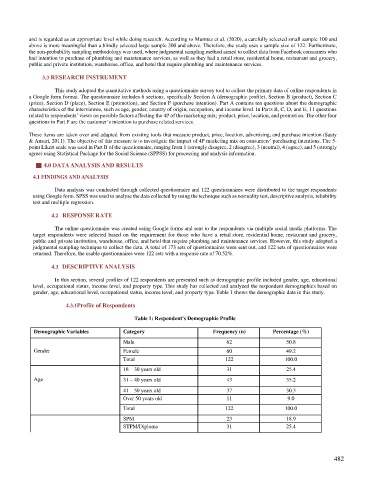
                   In this section, several profiles of 122 respondents are presented such as demographic profile included gender, age, educational
            level, occupational status, income level, and property type. This study has collected and analyzed the respondent demographics based on
            gender, age, educational level, occupational status, income level, and property type. Table 1 shows the demographic data in this study.

                       4.3.1 Profile of Respondents

                                             Table 1: Respondent’s Demographic Profile

            Demographic Variables         Category                     Frequency (n)       Percentage (%)
                                          Male                              62                  50.8
            Gender                        Female                            60                  49.2
                                          Total                             122                100.0
                                          18 – 30 years old                 31                  25.4
            Age                           31 – 40 years old                 43                  35.2
                                          41 – 50 years old                 37                  30.3
                                          Over 50 years old                 11                  9.0
                                          Total                             122                100.0
                                          SPM                               23                  18.9
                                          STPM/Diploma                      31                  25.4


                                                                                                                482

