


Page 646 - MARSIUM'21 COMP OF PAPER
P. 646
Qamarina & Zuraidah (2022)


               people all the time. An appeal on advertising will attract more customers and one satisfied customer will promote the company
               brand through word of mouth (Word of Mouth). Therefore, the following hypothesis was generated:
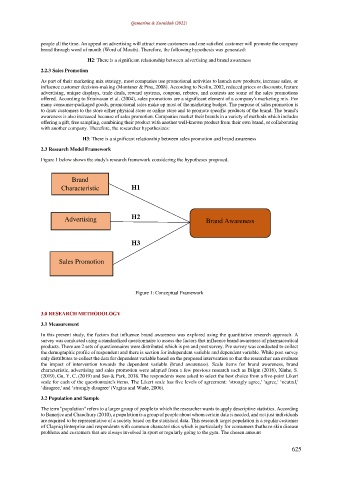
                                H2: There is a significant relationship between advertising and brand awareness

               2.2.3 Sales Promotion
               As part of their marketing mix strategy, most companies use promotional activities to launch new products, increase sales, or
               influence customer decision-making (Montaner & Pina, 2008). According to Neslin, 2002, reduced prices or discounts, feature
               advertising, unique displays, trade deals, reward systems, coupons, rebates, and contests are some of the sales promotions
               offered. According to Srinivasan et al. (2004), sales promotions are a significant element of a company's marketing mix. For
               many consumer-packaged goods, promotional sales make up most of the marketing budget. The purpose of sales promotion is
               to draw customers to the store either physical store or online store and to promote specific products of the brand. The brand's
               awareness is also increased because of sales promotion. Companies market their brands in a variety of methods which includes
               offering a gift, free sampling, combining their product with another well-known product from their own brand, or collaborating
               with another company. Therefore, the researcher hypothesizes:
                              H3: There is a significant relationship between sales promotion and brand awareness
               2.3 Research Model Framework
               Figure 1 below shows the study's research framework considering the hypotheses proposed.

                          Brand
                       Characteristic          H1


                        Advertising            H2                        Brand Awareness


                                               H3


                      Sales Promotion


                                                 Figure 1: Conceptual Framework


               3.0 RESEARCH METHODOLOGY
               3.1 Measurement

               In this present study, the factors that influence brand awareness was explored using the quantitative research approach. A
               survey was conducted using a standardized questionnaire to assess the factors that influence brand awareness of pharmaceutical
               products. There are 2 sets of questionnaires were distributed which is pre and post survey. Pre survey was conducted to collect
               the demographic profile of respondent and there is section for independent variable and dependent variable. While post survey
               only distributes to collect the data for dependent variable based on the proposed intervention so that the researcher can evaluate
               the  impact  of  intervention  towards  the  dependent  variable  (brand  awareness).  Scale  items  for  brand  awareness,  brand
               characteristic, advertising and sales promotion were adapted from a few previous research such as Bilgin (2018), Xinhe, S.
               (2019), Gu, Y. C. (2019) and Seo & Park, 2018. The respondents were asked to select the best choice from a five-point Likert
               scale for each of the questionnaire's items. The Likert scale has five levels of agreement: ‘strongly agree,' ‘agree,' ‘neutral,'
               ‘disagree,' and ‘strongly disagree' (Vagias and Wade, 2006).

               3.2 Population and Sample
               The term "population" refers to a larger group of people to which the researcher wants to apply descriptive statistics. According
               to Banerjee and Chaudhury (2010), a population is a group of people about whom certain data is needed, and not just individuals
               are required to be representative of a society based on the statistical data. This research target population is a regular customer
               of Clayniq Enterprise and respondents with common characteristics which is particularly for consumers that have skin disease
               problems and customers that are always involved in sport or regularly going to the gym. The chosen amount


                                                                                                        625

