


Page 752 - MARSIUM'21 COMP OF PAPER
P. 752
731                                        Alya (2022)

            1.2 SWOT ANALYSIS
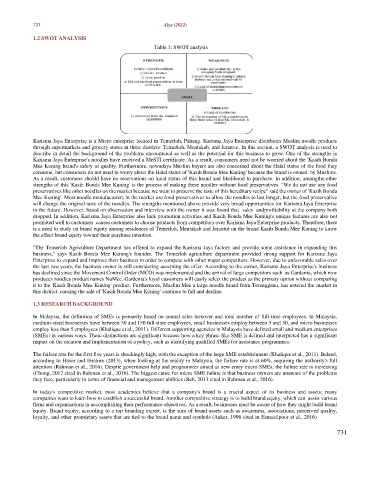
                                                    Table 1: SWOT analysis


            Karisma Jaya Enterprise is a Micro enterprise located in Temerloh, Pahang. Karisma Jaya Enterprise distributes Muslim noodle products
            through supermarkets and grocery stores in three districts: Temerloh, Mentakab, and Jerantut. In this section, a SWOT analysis is used to
            describe in detail the background of the problems encountered as well as the potential for this business to grow. One of the strengths is
            Karisma Jaya Enterprise's noodles have received a MeSTI certificate. As a result, consumers need not be worried about the 'Kasih Bonda
            Mee Kuning brand's safety or quality. Furthermore, nowadays Muslim buyers are also concerned about the Halal status of the food they
            consume, but consumers do not need to worry about the Halal status of 'Kasih Bonda Mee Kuning' because the brand is owned  by Muslims.
            As a result, customers should have no reservations on halal status of this brand and likelihood to purchase. In addition, among the other
            strengths of this 'Kasih Bonda Mee Kuning' is the process of making these noodles without food preservatives. "We do not use any food
            preservatives like other noodles on the market because we want to preserve the taste of this hereditary recipe" said the owner of 'Kasih Bonda
            Mee Kuning'. Most noodle manufacturers in the market use food preservatives to allow the noodles to last longer, but the food preservative
            will change the original taste of the noodles. The strengths mentioned above provide very broad opportunities for Karisma Jaya Enterprise
            in the future. However, based on observation and interview with the owner it was found that  sales  and profitability at the company both
            dropped. In addition, Karisma Jaya Enterprise also lack promotion activities and Kasih Bonda Mee Kuning's unique features are also not
            promoted well to customers  causes customers to choose products from competitors over Karisma Jaya Enterprise products. Therefore, there
            is a need to study on brand equity among residences of Temerloh, Mentakab and Jerantut on the brand Kasih Bonda Mee Kuning to know
            the effect brand equity toward their purchase intention.

            "The Temerloh Agriculture Department has offered to expand the Karisma Jaya factory and provide some assistance in expanding  this
            business,"  says  Kasih  Bonda  Mee  Kuning's  founder.  The  Temerloh  agriculture  department  provided  strong  support  for  Karisma  Jaya
            Enterprise to expand and improve their business in order to compete with other major competitors. However, due to unfavorable sales over
            the last two years, the business owner is still considering accepting the offer. According to the owner, Karisma Jaya Enterprise's business
            has declined since the Movement Control Order (MCO) was implemented and the arrival of large competitors such  as Gardenia, which now
            produces noodles product names NuMee. Gardenia's loyal customers will easily select the product as the primary option without comparing
            it to the 'Kasih Bonda Mee Kuning' product. Furthermore, Muslim Mee a large noodle brand from Terengganu, has entered the market in
            this district, causing the sale of 'Kasih Bonda Mee Kuning' continue to fall and decline.

            1.3 RESEARCH BACKGROUND

            In Malaysia, the definition of SMEs is primarily based on annual sales turnover and total number of full-time employees. In Malaysia,
            medium-sized businesses have between 50 and 150 full-time employees, small businesses employ between 5 and 50, and micro businesses
            employ less than 5 employees (Khalique et al., 2011). Different supporting agencies in Malaysia have defined small and medium enterprises
            (SMEs) in various ways. These distinctions are significant because how a key phrase like SME is defined and interpreted has a significant
            impact on the creation and implementation of a policy, such as identifying qualified SMEs for assistance programmes.

            The failure rate for the first five years is shockingly high, with the exception of the large SME establishment (Khalique et al., 2011). Indeed,
            according to Husin and Ibrahim (2013), when looking at the reality in Malaysia, the failure rate is at 60%, requiring the authority's full
            attention (Rahman et al., 2016). Despite government help and programmes aimed at new-entry micro SMEs, the failure rate is increasing
            (Chong, 2012 cited in Rahman et al., 2016). The biggest cause for micro SME failure is that business owners are unaware of the problems
            they face, particularly in terms of financial and management abilities (Beh, 2013 cited in Rahman et al., 2016).

            In  today's  competitive  market,  most  academics  believe  that  a  company's  brand  is  a  crucial  aspect  of  its  business  and  assets;  many
            companies want to learn how to establish a successful brand. Another competitive strategy is to build brand equity, which can  assist various
            firms and organisations in accomplishing their performance objectives. As a result, businesses must be aware of how they might build brand
            equity. Brand equity, according to a top branding expert, is the sum of brand assets such as awareness, associations, perceived quality,
            loyalty, and other proprietary assets that are tied to the brand name and symbols (Aaker, 1996 cited in Esmaeilpour et al., 2016).

                                                                                                                 731

