


Page 755 - MARSIUM'21 COMP OF PAPER
P. 755
734                                        Alya (2022)


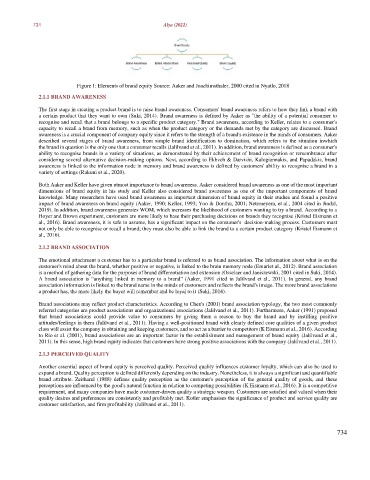
                          Figure 1: Elements of brand equity Source: Aaker and Joachimsthaler, 2000 cited in Nyatlo, 2018
              2.1.1 BRAND AWARENESS

              The first stage in creating a product brand is to raise brand awareness. Consumers' brand awareness refers to how they link a brand with
              a certain product that they want to own (Suki, 2014). Brand awareness is defined by Aaker as "the ability of a potential consumer to
              recognise and recall that a brand belongs to a specific product category." Brand awareness, according to Keller, relates to a consumer's
              capacity to recall a brand from memory, such as when the product category or the demands met by the category are discussed. Brand
              awareness is a crucial component of company equity since it refers to the strength of a brand's existence in the minds of consumers. Aaker
              described  several  stages of  brand  awareness,  from  simple brand  identification  to  domination,  which  refers  to  the  situation  in which
              the brand in question is the only one that a consumer recalls (Jalilvand et al., 2011). In addition, brand awareness is defined as a consumer's
              ability to recognise brands in a variety of situations, as demonstrated by their achievement of brand recognition or remembrance after
              considering several alternative decision-making options. Next, according to Ekhveh & Darvishi, Kalogiannakis, and Papadakis, brand
              awareness is linked to the information node in memory and brand awareness is defined by customers' ability to recognise a brand in a
              variety of settings (Rukuni et al., 2020).

              Both Aaker and Keller have given utmost importance to brand awareness. Aaker considered brand awareness as one of the most important
              dimensions  of  brand  equity  in  his  study  and  Keller  also  considered  brand  awareness  as  one of  the  important  components  of  brand
              knowledge. Many researchers have used brand awareness as important dimension of brand equity in their studies and found a positive
              impact of brand awareness on brand equity (Aaker, 1990; Keller, 1993; Yoo & Donthu, 2001; Netemeyera, et al., 2004 cited in Jindal,
              2019). In addition, brand awareness generates WOM, which increases the likelihood of customers wanting to try a brand. According to a
              Hoyer and Brown experiment, customers are more likely to base their purchasing decisions on brands they recognise (Kristel Eismann et
              al., 2016). Brand awareness, it is safe to assume, has a significant impact on the consumer's  decision-making process. Customers must
              not only be able to recognise or recall a brand; they must also be able to link the brand to a certain product category (Kristel Eismann et
              al., 2016).

              2.1.2 BRAND ASSOCIATION

              The emotional attachment a customer has to a particular brand is referred to as brand association. The information about what is on the
              customer's mind about the brand, whether positive or negative, is linked to the brain memory node (Emariet al., 2012). Brand association
              is a method of gathering data for the purposes of brand differentiation and extension (Osselaer and Janiszewski, 2001 cited in Suki, 2014).
              A brand association is “anything linked in memory to a brand” (Aaker, 1991 cited  in Jalilvand et  al., 2011). In general, any brand
              association information is linked to the brand name in the minds of customers and reflects the brand's image. The more brand associations
              a product has, the more likely the buyer will remember and be loyal to it (Suki, 2014).

              Brand associations may reflect product characteristics. According to Chen's (2001) brand association typology, the two most commonly
              referred categories are product associations and organizational associations (Jalilvand et al., 2011). Furthermore, Aaker (1991) proposed
              that  brand  associations  could  provide  value  to  consumers  by  giving  them  a  reason  to  buy  the  brand  and  by  instilling  positive
              attitudes/feelings in them (Jalilvand et al., 2011). Having a well-positioned brand with clearly defined core qualities of a given product
              class will assist the company in obtaining and keeping customers, and so act as a barrier to competitors (K Eismann et al., 2016). According
              to Rio et al. (2001), brand associations are an important factor in the establishment and management of brand equity (Jalilvand et al.,
              2011). In this sense, high brand equity indicates that customers have strong positive associations with the company (Jalilvand et al., 2011).

              2.1.3 PERCEIVED QUALITY

              Another essential aspect of brand equity is perceived quality. Perceived quality influences customer loyalty, which can also be used to
              expand a brand. Quality perception is defined differently depending on the industry. Nonetheless, it is always a significant and quantifiable
              brand  attribute.  Zeithaml  (1988)  defines  quality  perception  as  the  customer's  perception  of  the  general  quality  of  goods,  and  these
              perceptions are influenced by the good's natural function in relation to competing possibilities (K Eismann et al., 2016). It is a competitive
              requirement, and many companies have made customer-driven quality a strategic weapon. Customers are satisfied and valued when their
              quality desires and preferences are consistently and profitably met. Kotler emphasises the significance of product and service quality are
              customer satisfaction, and firm profitability (Jalilvand et al., 2011).


                                                                                                                 734

