


Page 783 - MARSIUM'21 COMP OF PAPER
P. 783
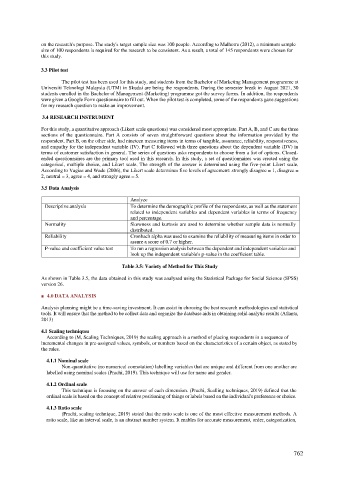
on the research's purpose. The study's target sample size was 100 people. According to Malhotra (2012), a minimum sample
                size of 100 respondents is required for the research to be consistent. As a result, a total of 145 respondents were chosen for
                this study.

               3.3 Pilot test

                       The pilot test has been used for this study, and students from the Bachelor of Marketing Management programme at
                Universiti Teknologi Malaysia (UTM) in Skudai are being the respondents. During the semester break in August 2021, 30
                students enrolled in the Bachelor of Management (Marketing) programme got the survey forms. In addition, the respondents
                were given a Google Form questionnaire to fill out. When the pilot test is completed, some of the respondents gave suggestions
                for my research question to make an improvement.

                3.4 RESEARCH INSTRUMENT

                For this study, a quantitative approach (Likert scale questions) was considered most appropriate. Part A, B, and C are the three
                sections  of  the  questionnaire.  Part  A  consists  of  seven  straightforward  questions  about  the  information  provided  by  the
                respondent. Part B, on the other side, had nineteen measuring items in terms of tangible, assurance, reliability, responsiveness,
                and empathy for the independent variable (IV). Part C followed with three questions about the dependent variable (DV) in
                terms of customer satisfaction in general. The series of questions asks respondents to choose from a list of options. Closed-
                ended questionnaires are the primary tool used in this research. In this study, a set of questionnaires was created using the
                categorical, multiple choice, and Likert scale. The strength of the answer is determined using the five-point Likert scale.
                According to Vagias and Wade (2006), the Likert scale determines five levels of agreement: strongly disagree = 1, disagree =
                2, neutral = 3, agree = 4, and strongly agree = 5.

               3.5 Data Analysis

                                               Analyze
                 Descriptive analysis          To determine the demographic profile of the respondents, as well as the statement
                                               related to independent variables and dependent variables in terms of frequency
                                               and percentage.
                 Normality                     Skewness and kurtosis are used to determine whether sample data is normally
                                               distributed.
                 Reliability                   Cronbach alpha was used to examine the reliability of measuring items in order to
                                               assure a score of 0.7 or higher.
                 P-value and coefficient value test   To run a regression analysis between the dependent and independent variables and
                                               look up the independent variable's p-value in the coefficient table.

                                            Table 3.5: Variety of Method for This Study

                As shown in Table 3.5, the data obtained in this study was analysed using the Statistical Package for Social Science (SPSS)
                version 26.

               ■  4.0 DATA ANALYSIS

                Analysis planning might be a time-saving investment. It can assist in choosing the best research methodologies and statistical
                tools. It will ensure that the method to be collect data and organize the database aids in obtaining solid analytic results (Atlanta,
                2013)

               4.1 Scaling techniques
                 According to (M, Scaling Techniques, 2019) the scaling approach is a method of placing respondents in a sequence of
                incremental changes in pre-assigned values, symbols, or numbers based on the characteristics of a certain object, as stated by
                the rules.

                 4.1.1 Nominal scale
                       Non-quantitative (no numerical connotation) labelling variables that are unique and different from one another are
                 labelled using nominal scales (Prachi, 2019). This technique will use for name and gender.

                 4.1.2 Ordinal scale
                       This technique is focusing on the answer of each dimension. (Prachi, Scalling techniques, 2019) defined that the
                 ordinal scale is based on the concept of relative positioning of things or labels based on the individual's preference or choice.

                 4.1.3 Ratio scale
                       (Prachi, scaling technique, 2019) stated that the ratio scale is one of the most effective measurement methods. A
                 ratio scale, like an interval scale, is an abstract number system. It enables for accurate measurement, order, categorization,


                                                                                                        762

