


Page 928 - MARSIUM'21 COMP OF PAPER
P. 928
929                                 Kelly & Mazilah (2021)


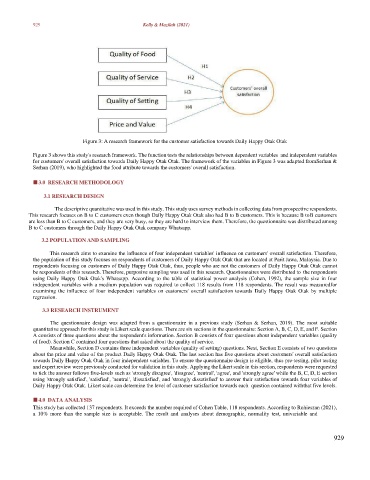
                            Figure 3: A research framework for the customer satisfaction towards Daily Happy Otak Otak

            Figure 3 shows this study's research framework. The function tests the relationships between dependent variables  and independent variables
            for customers' overall satisfaction towards Daily Happy Otak Otak. The framework of the variables in Figure 3 was adapted from Serhan &
            Serhan (2019), who highlighted the food attribute towards the customers' overall satisfaction.

            ■ 3.0  RESEARCH METHODOLOGY

               3.1 RESEARCH DESIGN

                   The descriptive quantitative was used in this study. This study uses survey methods in collecting data from prospective respondents.
           This research focuses on B to C customers even though Daily Happy Otak Otak also had B to B customers. This is because B to B customers
           are less than B to C customers, and they are very busy, so they are hard to interview them. Therefore, the questionnaire was distributed among
           B to C customers through the Daily Happy Otak Otak company Whatsapp.

               3.2 POPULATION AND SAMPLING

                 This research aims to examine the influence of four independent variables' influence on customers' overall satisfaction. Therefore,
            the population of this study focuses on respondents of customers of Daily Happy Otak Otak that are located at Parit Jawa, Malaysia. Due to
            respondents focusing on customers of Daily Happy Otak Otak, thus, people who are not the customers of Daily Happy Otak Otak cannot
            be respondents of this research. Therefore, purposive sampling was used in this research. Questionnaires were distributed to  the respondents
            using Daily Happy Otak Otak's Whatsapp. According to the table of statistical power analysis (Cohen, 1992), the sample size  in four
            independent variables with a medium population was required to collect 118 results from 118 respondents. The result was measured for
            examining  the  influence  of  four  independent  variables  on  customers'  overall  satisfaction  towards  Daily  Happy  Otak  Otak by  multiple
            regression.

               3.3 RESEARCH INSTRUMENT

                  The  questionnaire  design  was  adapted  from  a  questionnaire  in  a  previous  study  (Serhan  &  Serhan,  2019).  The  most  suitable
            quantitative approach for this study is Likert scale questions. There are six sections in the questionnaire: Section A, B, C, D, E, and F. Section
            A consists of three questions about the respondent's information. Section B consists of four questions about independent variables (quality
            of food). Section C contained four questions that asked about the quality of service.
                  Meanwhile, Section D contains three independent variables (quality of setting) questions. Next, Section E consists of two questions
            about the price and value of the product Daily Happy Otak Otak. The last section has five questions about customers' overall satisfaction
            towards Daily Happy Otak Otak in four independent variables. To ensure the questionnaire design is eligible, thus pre-testing, pilot testing
            and expert review were previously conducted for validation in this study. Applying the Likert scale in this section, respondents were requested
            to tick the answer follows five-levels such as 'strongly disagree', 'disagree', 'neutral', 'agree', and 'strongly agree' while the B, C, D, E section
            using 'strongly satisfied', 'satisfied', 'neutral', 'dissatisfied', and 'strongly dissatisfied' to answer their satisfaction towards four variables of
            Daily Happy Otak Otak. Likert scale can determine the level of customer satisfaction towards each  question contained with that five levels.

            ■ 4.0  DATA ANALYSIS
            This study has collected 137 respondents. It exceeds the number required of Cohen Table, 118 respondents. According to Rohieszan (2021),
            a  10%  more  than  the  sample  size  is  acceptable.  The  result  and  analyses  about  demographic,  normality  test,  univariable  and


                                                                                                                929

