


Page 73 - Health, Population and Environment Education 9
P. 73
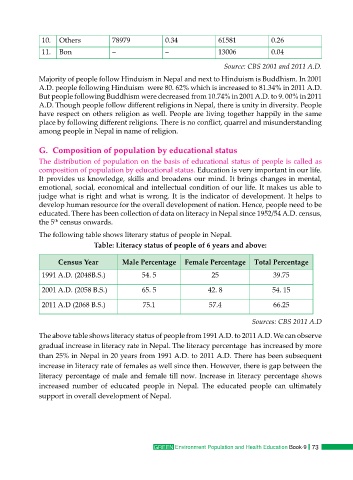
10.  Others          78979          0.34           61581           0.26
             11.  Bon             –              –              13006           0.04

                                                                  Source: CBS 2001 and 2011 A.D.
            Majority of people follow Hinduism in Nepal and next to Hinduism is Buddhism. In 2001
            A.D. people following Hinduism  were 80. 62% which is increased to 81.34% in 2011 A.D.
            But people following Buddhism were decreased from 10.74% in 2001 A.D. to 9. 00% in 2011
            A.D. Though people follow different religions in Nepal, there is unity in diversity. People
            have respect on others religion as well. People are living together happily in the same
            place by following different religions. There is no conflict, quarrel and misunderstanding
            among people in Nepal in name of religion.

            G.  Composition of population by educational status
            The distribution of population on the basis of educational status of people is called as
            composition of population by educational status. Education is very important in our life.
            It provides us knowledge, skills and broadens our mind. It brings changes in mental,
            emotional, social, economical and intellectual condition of our life. It makes us able to
            judge what is right and what is wrong. It is the indicator of development. It helps to
            develop human resource for the overall development of nation. Hence, people need to be
            educated. There has been collection of data on literacy in Nepal since 1952/54 A.D. census,
            the 5  census onwards.
                 th
            The following table shows literary status of people in Nepal.
                            Table: Literacy status of people of 6 years and above:

                  Census Year       Male Percentage    Female Percentage   Total Percentage
             1991 A.D. (2048B.S.)         54. 5                25               39.75

             2001 A.D. (2058 B.S.)        65. 5              42. 8              54. 15
             2011 A.D (2068 B.S.)          75.1               57.4              66.25


                                                                          Sources: CBS 2011 A.D
            The above table shows literacy status of people from 1991 A.D. to 2011 A.D. We can observe
            gradual increase in literacy rate in Nepal. The literacy percentage  has increased by more
            than 25% in Nepal in 20 years from 1991 A.D. to 2011 A.D. There has been subsequent
            increase in literacy rate of females as well since then. However, there is gap between the
            literacy percentage of male and female till now. Increase in literacy percentage shows
            increased number of educated people in Nepal. The educated people can ultimately
            support in overall development of Nepal.


                                              GREEN  Environment Population and Health Education Book-9 73

