


Page 77 - Health, Population and Environment Education 9
P. 77
In the above table, population density of urban areas was 985 per sq. km in 2001 A.D. and
            increased to 1380 per sq. km in 2011 A.D. Population density of rural areas was 138 per
            sq. km in 2001 A.D. and reached 158 per sq. km in 2011 A.D. The increase in population
            density of both urban and rural areas shows that there is overall increase of population in
            Nepal. However, there is huge difference in population density in urban areas and rural
            areas.
             Activity: 1

             Make a list of people of 10 houses in your locality on the basis of their caste, language,
             sex, age, religion, occupation and educational status. Prepare a report and submit to
             your subject teacher.


              4.4   Population Distribution

            The arrangement of population with respect to geographical regions, administrative
            division like mountain, hills, terai, town, village, district, zone, etc. is called as population
            distribution. It indicates how many people and where are they distributed in a place. The
            data on population distribution supports the government, organization and individuals
            to develop plan and policies based on their location and resources available.
            There is difference in land topography, climate, cultivable land, soil structure, availability
            of  natural  resources  and  facilities  in  different  parts  of  Nepal.  Hence  the  population
            distribution is not same in all the places. Population distribution is more in urban areas
            and terai region whereas less in mountain region and rural areas.

            Population Distribution by Geographical Regions

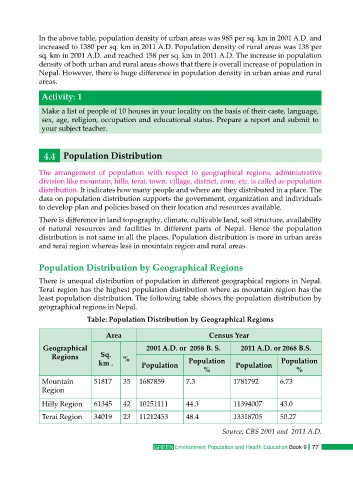
            There is unequal distribution of population in different geographical regions in Nepal.
            Terai region has the highest population distribution where as mountain region has the
            least population distribution. The following table shows the population distribution by
            geographical regions in Nepal.
                          Table: Population Distribution by Geographical Regions

                                Area                          Census Year
             Geographical                   2001 A.D. or  2058 B. S.   2011 A.D. or 2068 B.S.
                Regions       Sq.    %
                              km .        Population    Population    Population   Population
                                                            %                          %
             Mountain       51817    35  1687859       7.3           1781792      6.73
             Region
             Hilly Region   61345    42  10251111      44.3          11394007     43.0

             Terai Region   34019    23  11212453      48.4          13318705     50.27
                                                                  Source: CBS 2001 and  2011 A.D.

                                              GREEN  Environment Population and Health Education Book-9 77

