


Page 78 - Health, Population and Environment Education 9
P. 78
In the above table, we can see that mountain region covers 35% of total area of Nepal. The
          population of mountain region decreased to 6.7% in 2011 A.D. from 7.3% in 2001 A.D.  Hilly
          region covers 42% of total area of Nepal and population decreased slightly in 2011 A.D.
          than that of 2001 A.D. Terai region covers only 23% of total area of Nepal. But more than
          50% of total population live in terai region. There is gradual increase of population in terai
          region because people from mountain and hilly region have migrated to terai region.
          In Nepal, the population is not equally distributed in all the geographical regions. There
          are several reasons behind it. Some of them are described as follows:

          a.  Land topography
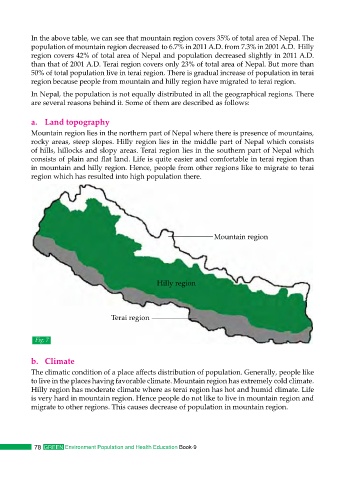
          Mountain region lies in the northern part of Nepal where there is presence of mountains,
          rocky areas, steep slopes. Hilly region lies in the middle part of Nepal which consists
          of hills, hillocks and slopy areas. Terai region lies in the southern part of Nepal which
          consists of plain and flat land. Life is quite easier and comfortable in terai region than
          in mountain and hilly region. Hence, people from other regions like to migrate to terai
          region which has resulted into high population there.


                                                               Mountain region


                                               Hilly region


                                 Terai region


           Fig: 7

          b.  Climate

          The climatic condition of a place affects distribution of population. Generally, people like
          to live in the places having favorable climate. Mountain region has extremely cold climate.
          Hilly region has moderate climate where as terai region has hot and humid climate. Life
          is very hard in mountain region. Hence people do not like to live in mountain region and
          migrate to other regions. This causes decrease of population in mountain region.


           78  GREEN Environment Population and Health Education Book-9

