


Page 218 - 9 teachers social book 9 @ 2077 ctp_Neat
P. 218
Lesson      Knowledge on Distance or Scale
           6.9
                       and Its Uses


                            FACTS        The scale is very important in drawing map because
                         to Understand   it reduces the actual shape and size of an object and
                                         show in a paper.


           A scale is a system of units for measuring. It is the series of marks at regular intervals
           for the purpose of measuring as we can see on a ruler. Maps are drawn according to
           scale in order to show the relative proportions of distance on the map similar to those
           on the ground. The scale has a vital role in drawing a map because the actual shape
           and size of an object is not possible to show on paper without a scale. A scale can be
           represented in three ways which are given below:

           1.  Representative Scale


                 It is represented in the form of fraction. It is also called numerical scale. It can
           be denoted in double ways through any of the following equations:
                                                    1
                                                 15000

           The numerator of the fraction signified the length on the map and the denominator
           indicates the length on the actual ground. Here, the numerator gets divided by the
           denominator. For example,  or 1:1000 which implies that 1 cm on the map justifies
           1000 cm on the earth surface. It does not require mentioning any unit of measurement
           such as cm, inches, feet of any other conventional units since both numerator and
           denominator are shown and understood in the same unit.

           2.  Linear Scale (Graphical Scale)

                 A linear or graphic scale is a straight line or ruler printed on a map. It looks
           like a ruler with its sub-division. It is divided into two parts: primary and extension.
           The part of scale right of the zero is primary scale with regular intervals of equal
           distances. The part lying left of the zero is extension scale with regular sub-divisions
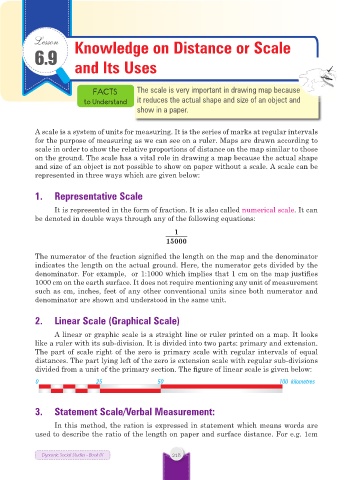
           divided from a unit of the primary section. The figure of linear scale is given below:
           0                 25                50                                 100  kilometres


           3.  Statement Scale/Verbal Measurement:

                 In this method, the ration is expressed in statement which means words are
           used to describe the ratio of the length on paper and surface distance. For e.g. 1cm


             Dynamic Social Studies - Book IX      218

