


Page 220 - 9 teachers social book 9 @ 2077 ctp_Neat
P. 220
Lesson
          6.10          The Physical Features of Asia


                            FACTS        Asia is the largest continent with diverse climate,
                         to Understand   soil, natural vegetation and resources. It is the
                                                                   rd
                                         common home for about 1/3   of the world population.


           Asia is the largest continent of the world that lies entirely in the northern hemisphere
           with the exception of some of the Islands of the East Indies. Asia extends from 10°S to
           80°N up to the frozen shores of the Arctic Ocean. There are 50 independent countries
           in Asia including the largest in size and the most populated country, China. It is
           surrounded by the Arctic Ocean, in the north, the pacific and the Indian Ocean in
           the east and in the south respectively. On the western side there are Ural Mountain,
           Caucasus Mountain and the Caspian Sea, Black Sea and the Red Sea. Its area is
           merged with  Europe in  Western  side. So together it is called  Eurasia. Asia has
                       rd
           occupied 1/3  of land having area of 4,50,36,492 sq. km of the world. It is the most
           populated continent of the world having about 59% of the total population living in
           this continent. So, Asia is called the common home to all the living beings.

           Physical Features

           Asia has all forms of land features, climate, soil and natural vegetation. It has the
           largest mountains, plains and plateaus in the world. Its features can be divided into
           5 physical regions.


           The Northern Mountains and Plateaus

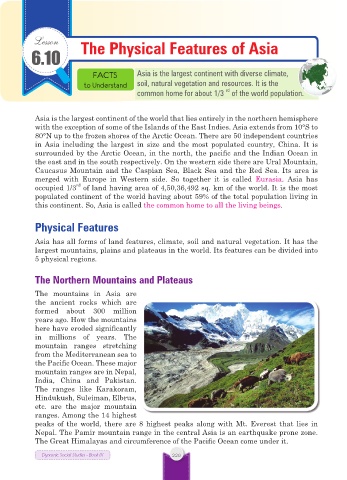
           The mountains  in Asia are
           the ancient rocks  which  are
           formed about 300 million
           years ago. How the mountains
           here have eroded significantly
           in  millions  of years.  The
           mountain ranges stretching
           from the Mediterranean sea to
           the Pacific Ocean. These major
           mountain ranges are in Nepal,
           India, China and Pakistan.
           The ranges like  Karakoram,
           Hindukush, Suleiman, Elbrus,
           etc.  are  the  major  mountain
           ranges. Among the 14 highest
           peaks of the world, there are 8 highest peaks along with Mt. Everest that lies in
           Nepal. The Pamir mountain range in the central Asia is an earthquake prone zone.
           The Great Himalayas and circumference of the Pacific Ocean come under it.
             Dynamic Social Studies - Book IX      220

