


Page 124 - Health, Population and Environment Education 10
P. 124
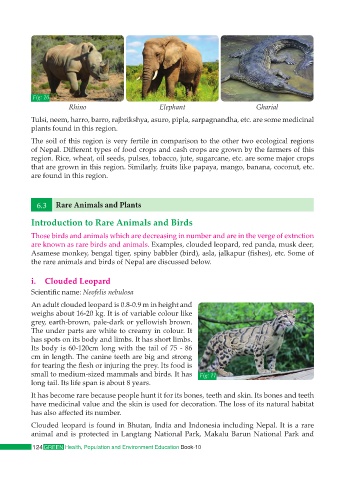
Fig: 10
                     Rhino                     Elephant                    Gharial

          Tulsi, neem, harro, barro, rajbrikshya, asuro, pipla, sarpagnandha, etc. are some medicinal
          plants found in this region.

          The soil of this region is very fertile in comparison to the other two ecological regions
          of Nepal. Different types of food crops and cash crops are grown by the farmers of this
          region. Rice, wheat, oil seeds, pulses, tobacco, jute, sugarcane, etc. are some major crops
          that are grown in this region. Similarly, fruits like papaya, mango, banana, coconut, etc.
          are found in this region.


            6.3  Rare Animals and Plants

          Introduction to Rare Animals and Birds

          Those birds and animals which are decreasing in number and are in the verge of extnction
          are known as rare birds and animals. Examples, clouded leopard, red panda, musk deer,
          Asamese monkey, bengal tiger, spiny babbler (bird), asla, jalkapur (fishes), etc. Some of
          the rare animals and birds of Nepal are discussed below.

          i.  Clouded Leopard
          Scientific name: Neofelis nebulosa
          An adult clouded leopard is 0.8-0.9 m in height and
          weighs about 16-20 kg. It is of variable colour like
          grey, earth-brown, pale-dark or yellowish brown.
          The under parts are white to creamy in colour. It
          has spots on its body and limbs. It has short limbs.
          Its body is 60-120cm long with the tail of 75 - 86
          cm in length. The canine teeth are big and strong
          for tearing the flesh or injuring the prey. Its food is
          small to medium-sized mammals and birds. It has  Fig: 11
          long tail. Its life span is about 8 years.

          It has become rare because people hunt it for its bones, teeth and skin. Its bones and teeth
          have medicinal value and the skin is used for decoration. The loss of its natural habitat
          has also affected its number.
          Clouded leopard is found in Bhutan, India and Indonesia including Nepal. It is a rare
          animal and is protected in Langtang National Park, Makalu Barun National Park and
          124  GREEN Health, Population and Environment Education Book-10

