


Page 45 - Health, Population and Environment Education 10
P. 45
there is very less chance of fertilization between sperm and ovum. This continues till
            few months only. Once, there is starting of menstruation cycle in lactating females, this
            method does not work.

            Artificial Contraceptive Methods

            The methods in which there is use of artificial devices to control birth of children are
            called artificial contraceptive methods.
            It is further divided into following two types as:

            i.   Temporary Contraceptive Method         ii.  Permanent Contraceptive Method

            i.   Temporary Contraceptive Method
            The method in which there is use of artificial devices to delay the pregnancy or birth of
            children for certain time period is called temporary contraceptive method. It is applied
            for birth spacing.

            There has been development of separate temporary contraceptive devices for both males
            and females. Males can use condom where as females have many more choices. They
            can use oral pills, foam tablet, IUCD, depoprovera injection, norplant, femidom, jelleys,
            ointments, etc. All of them are explained in brief.
            Temporary contraceptive device for male:

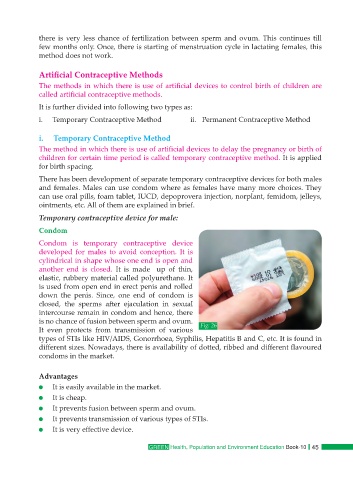
            Condom
            Condom  is temporary contraceptive device
            developed for males to avoid conception. It is
            cylindrical in shape whose one end is open and
            another end is closed. It is made  up of thin,
            elastic, rubbery material called polyurethane. It
            is used from open end in erect penis and rolled
            down the penis. Since, one end of condom  is
            closed,  the  sperms  after  ejaculation  in  sexual
            intercourse remain in condom and hence, there
            is no chance of fusion between sperm and ovum.   Fig: 26
            It even protects from transmission of various
            types of STIs like HIV/AIDS, Gonorrhoea, Syphilis, Hepatitis B and C, etc. It is found in
            different sizes. Nowadays, there is availability of dotted, ribbed and different flavoured
            condoms in the market.

            Advantages
                It is easily available in the market.
                It is cheap.
                It prevents fusion between sperm and ovum.
                It prevents transmission of various types of STIs.
                It is very effective device.

                                            GREEN  Health, Population and Environment Education Book-10 45

