


Page 279 - leadership-experience-2008
P. 279
CikguOnline
      CikguOnline
            260                                                               PART 4: THE LEADER AS A RELATIONSHIP BUILDER
                                   that some senior executives in particular are not investing the time and  energy to
                                   be effective communicators, which can leave the entire organization fl oundering for
                                   direction or prevent top leaders from adequately responding to problems or oppor-
                                   tunities. Many top managers, for example, resist employee feedback, because they
                                   don’t want to hear negative information. Without feedback, though, leaders often
                                   make decisions and plans that are out of alignment with employee perceptions,
                                   making smooth implementation less likely. 4
                                       This chapter describes tools and skills that can be used to overcome the com-

                                   munication deficit pervading today’s organizations and the broader social world.
                                   We also examine how leaders use communication skills to make a difference in
                                   their organizations and the lives of followers.


                                   How Leaders Communicate
                                   We have all had both positive and negative experiences with communication in
                                   our personal as well as our work lives. Have you ever had a supervisor or instruc-
                                   tor whose communication skills were so poor that you didn’t have any idea what
                                   was expected of you or how to accomplish the job you were asked to do? On the
                                   other hand, have you experienced the communication flair of a teacher, boss, or

                                   coach who “painted a picture in words” that both inspired you and clarifi ed how
                                   to achieve an objective?
                                       Leadership means communicating with others in such a way that they are
                                   infl uenced and motivated to perform actions that further common goals and lead
            Communication          toward desired outcomes. Communication is a process by which information and
            a process by which information   understanding are transferred between a sender and a receiver, such as between
            and understanding are
            transferred between a sender   a leader and an employee, an instructor and a student, or a coach and a foot-
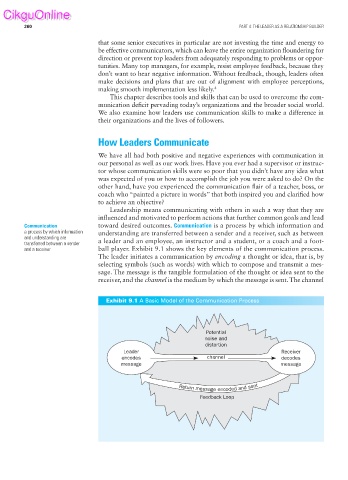
            and a receiver         ball player. Exhibit 9.1 shows the key elements of the communication process.
                                   The leader initiates a communication by encoding a thought or idea, that is, by
                                   selecting symbols (such as words) with which to compose and transmit a mes-
                                   sage. The message is the tangible formulation of the thought or idea sent to the
                                   receiver, and the channel is the medium by which the message is sent. The channel


                                     Exhibit 9.1 A Basic Model of the Communication Process


                                                                    Potential
                                                                    noise and
                                                                    distortion
                                           Leader                                          Receiver
                                          encodes                    channel               decodes
                                          message                                          message


                                                            Return message encoded and sent
                                                                  Feedback Loop

