


Page 283 - leadership-experience-2008
P. 283
CikguOnline
      CikguOnline
            264                                                               PART 4: THE LEADER AS A RELATIONSHIP BUILDER
                                     organizational success; and (3) selecting the right communication channels and
                                   facilitating dialogue.  An example of strategic conversation comes from Royal
                                                     9
                                   Philips Electronics, Europe’s largest electronics outfit. President Gerard Kleisterlee

                                   outlined four key technology themes that he believes should define Philips’ future in

                                   the industry: display, storage, connectivity, and digital video processing.  These
                                   themes intentionally cross technology boundaries and require people to communi-
                                   cate and collaborate across departments and divisions. A strategic conversation for
                                   each theme begins with a one-day summit that brings together everyone who has
                                   relevant information to contribute—regardless of rank or job position—so that
                                   people can together gain a clear sense of goals and establish cooperative working
                                   relationships. 10
                                       Five key components necessary for strategic conversations are an open com-
                                   munication climate, asking questions, active listening, discernment, and dialogue.

                                   Creating an Open Communication Climate
            Open communication     Open communication means sharing all types of information throughout the orga-
            Open communication
            leaders sharing all types of   nization, especially across functional and hierarchical boundaries. Open commu-
            leaders sharing all types of
            information throughout the
            information throughout the

            company and across all levels
            company and across all levels  nication runs counter to the traditional flow of selective information downward
                                   from supervisors to subordinates. But leaders want communication to fl ow in
                                   all directions. People throughout the organization need a clear direction and an
                                   understanding of how they can contribute.  A recent survey of U.S. employees
                                                                         11
                                   reveals that people genuinely want open and honest communication from their
                                   leaders, including the bad news as well as the good. Yet when these employees
                                   were asked to evaluate how well their leaders were doing on a scale of zero to
                                   100, the average score was 69. 12
                                       To build an open communication climate, leaders break down conventional
                                   hierarchical and departmental boundaries that may be barriers to communi-
                                   cation, enabling them to convey a stronger awareness of and commitment to
                                   organizational vision, goals, and values. In an open climate, a leader’s communica-
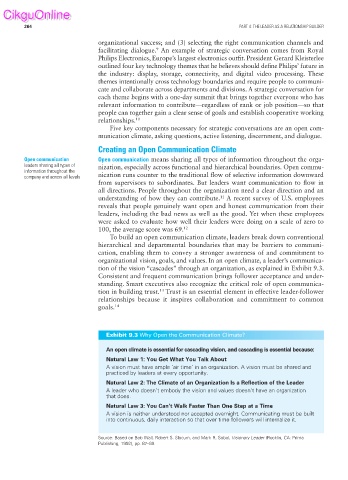
                                   tion of the vision “cascades” through an organization, as explained in Exhibit 9.3.
                                   Consistent and frequent communication brings follower acceptance and under-
                                   standing. Smart executives also recognize the critical role of open communica-
                                   tion in building trust.  Trust is an essential element in effective leader-follower
                                                      13
                                   relationships because it inspires collaboration and commitment to common
                                   goals. 14


                                     Exhibit 9.3 Why Open the Communication Climate?

                                     An open climate is essential for cascading vision, and cascading is essential because:
                                     Natural Law 1: You Get What You Talk About
                                     A vision must have ample ‘air time’ in an organization. A vision must be shared and
                                     practiced by leaders at every opportunity.
                                     Natural Law 2: The Climate of an Organization Is a Reflection of the Leader
                                     A leader who doesn’t embody the vision and values doesn’t have an organization
                                     that does.
                                     Natural Law 3: You Can’t Walk Faster Than One Step at a Time
                                     A vision is neither understood nor accepted overnight. Communicating must be built
                                     into continuous, daily interaction so that over time followers will internalize it.


                                   Source: Based on Bob Wall, Robert S. Slocum, and Mark R. Sobol, Visionary Leader (Rocklin, CA: Prima
                                   Publishing, 1992), pp. 87–89.

