


Page 286 - leadership-experience-2008
P. 286
CikguOnline
         CikguOnline
               CHAPTER 9: LEADERSHIP COMMUNICATION                                                       267

               strategic themes and understand how to influence others to achieve desired out-
               comes. Listening helps create an open communication climate, because people are
               willing to share their ideas, suggestions, and problems when they think someone
               is listening and genuinely values what they have to say.
                   Listening involves the skill of grasping and interpreting a message’s genuine   Listening
                                                                                        Listening
                                                                                        the skill of grasping and
               meaning. Remember that message reception is a vital link in the communication   the skill of grasping and
                                                                                        interpreting a message’ s genuine
                                                                                        interpreting a message’s genuine
               process. However, many people do not listen effectively. They concentrate on for-  meaning
                                                                                        meaning
               mulating what they’re going to say next rather than on what is being said to them.
               Our listening efficiency, as measured by the amount of material understood and

               remembered by subjects 48 hours after listening to a 10-minute message, is, on
               average, no better than 25 percent. 23
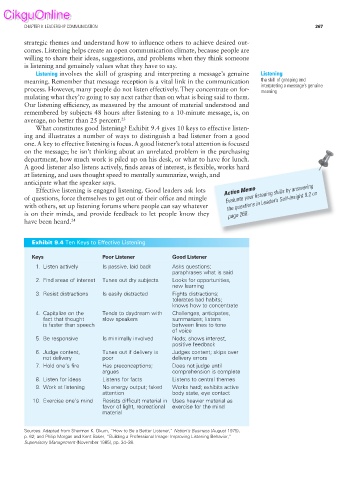
                   What constitutes good listening? Exhibit 9.4 gives 10 keys to effective listen-
               ing and illustrates a number of ways to distinguish a bad listener from a good
               one. A key to effective listening is focus. A good listener’s total attention is focused
               on the message; he isn’t thinking about an unrelated problem in the purchasing
               department, how much work is piled up on his desk, or what to have for lunch.


               A good listener also listens actively, finds areas of interest, is flexible, works hard
               at listening, and uses thought speed to mentally summarize, weigh, and
               anticipate what the speaker says.
                                                                              Evaluate your listening skills by answering
                   Effective listening is engaged listening. Good leaders ask lots   Action Memo

               of questions, force themselves to get out of their office and mingle   the questions in Leader’s Self-Insight 9.2 on
               with others, set up listening forums where people can say whatever
               is on their minds, and provide feedback to let people know they   page 268.
               have been heard. 24


                  Exhibit 9.4 Ten Keys to Effective Listening

                  Keys                 Poor Listener         Good Listener
                    1.  Listen actively   Is passive, laid back   Asks questions;
                                                             paraphrases what is said
                    2.  Find areas of interest   Tunes out dry subjects   Looks for opportunities,
                                                             new learning
                    3.  Resist distractions   Is easily distracted   Fights distractions;
                                                             tolerates bad habits;
                                                             knows how to concentrate
                   4.   Capitalize on the   Tends to daydream with   Challenges, anticipates,
                     fact that thought   slow speakers       summarizes; listens
                     is faster than speech                   between lines to tone
                                                             of voice
                    5.  Be responsive   Is minimally involved   Nods; shows interest,
                                                             positive feedback
                   6.   Judge content,   Tunes out if delivery is    Judges content; skips over
                     not delivery      poor                  delivery errors
                    7.  Hold one’s fire   Has preconceptions;    Does not judge until
                                       argues                comprehension is complete
                    8.  Listen for ideas   Listens for facts   Listens to central themes
                    9.  Work at listening   No energy output; faked   Works hard; exhibits active
                                       attention             body state, eye contact
                   10.  Exercise one’s mind   Resists difficult material in  Uses heavier material as
                                       favor of light, recreational   exercise for the mind
                                       material


               Sources: Adapted from Sherman K. Okum, “How to Be a Better Listener,” Nation’s Business (August 1975),
               p. 62; and Philip Morgan and Kent Baker, “Building a Professional Image: Improving Listening Behavior,”
               Supervisory Management (November 1985), pp. 34–38.

