


Page 295 - leadership-experience-2008
P. 295
CikguOnline
      CikguOnline
            276                                                               PART 4: THE LEADER AS A RELATIONSHIP BUILDER
                                   speed and reduced the cost of long-distance communication in particular. Rather
                                   than playing “phone tag,” a leader or employee can send an e-mail message to
                                   communicate necessary information. A recent survey by Ohio State University
                                   researchers found that about half of the respondents reported making fewer tele-
                                   phone calls since they began using e-mail. However, respondents also said they
                                   preferred the telephone or face-to-face conversations for expressing affection, giv-
                                   ing advice, or communicating diffi cult news. 41
                                       Some studies have found that e-mail, instant messaging, and other forms of
                                   electronic communication can enable reasonably rich communication if the tech-
                                                            42
                                   nology is used appropriately.  However, the proliferation of electronic media has
                                   contributed to  poorer communication in many organizations. Employees who
                                   work in offices down the hall from one another will often send e-mail rather

                                   than communicating face to face. One employee reported that he was fi red via
                                   e-mail—by a manager who sat fi ve feet away in the same offi ce. 43
                                       Other forms of electronic communication, such as video conferencing, rec-
                                   ognize the need for channel richness, allowing for voice as well as body language
                                   cues. A lower level of richness is offered by the World Wide Web and company
                                   intranets, but these have opened new avenues for keeping in touch with employ-
                                   ees and customers. An intranet enables leaders to disseminate certain types of
                                   information to a huge number of employees simultaneously, such as a traditional
                                   company newsletter might. Company Web pages and Web logs, or blogs, are in-
                                   creasingly being used to keep in closer touch with customers, suppliers, employees,
                                   and partners, and unlike print media, the Web allows for rapid feedback.
                                       Written media such as notes and letters can be personalized, but they convey
                                   only the cues written on paper and are slow to provide feedback. Impersonal
                                          written media, including fliers, bulletins, and standard computer reports,

                                               are the lowest in richness. The channels are not focused on a single
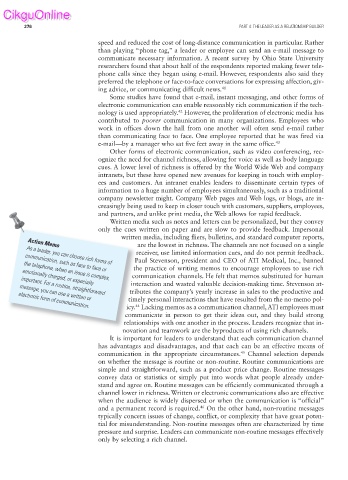
             Action Memo
                                               receiver, use limited information cues, and do not permit feedback.
                                              Paul Stevenson, president and CEO of ATI Medical, Inc., banned
             As a leader, you can choose rich forms of
                                              the practice of writing memos to encourage employees to use rich
            communication, such as face to face or
                                             communication channels. He felt that memos substituted for human
            the telephone, when an issue is complex,
                                             interaction and wasted valuable decision-making time. Stevenson at-
            emotionally charged, or especially
                                             tributes the company’s yearly increase in sales to the productive and
           important. For a routine, straightforward
           message, you can use a written or
                                            timely personal interactions that have resulted from the no-memo pol-
                                            icy.  Lacking memos as a communication channel, ATI employees must
                                              44
          electronic form of communication.
                                           communicate in person to get their ideas out, and they build strong
                                           relationships with one another in the process. Leaders recognize that in-
                                          novation and teamwork are the byproducts of using rich channels.
                                       It is important for leaders to understand that each communication channel
                                   has advantages and disadvantages, and that each can be an effective means of
                                                                               45
                                   communication in the appropriate circumstances.  Channel selection depends
                                   on whether the message is routine or non-routine. Routine communications are
                                   simple and straightforward, such as a product price change. Routine messages
                                   convey data or statistics or simply put into words what people already under-
                                   stand and agree on. Routine messages can be effi ciently communicated through a
                                   channel lower in richness. Written or electronic communications also are effective
                                   when the audience is widely dispersed or when the communication is “offi cial”
                                                                  46
                                   and a permanent record is required.  On the other hand, non-routine messages

                                   typically concern issues of change, conflict, or complexity that have great poten-
                                   tial for misunderstanding. Non-routine messages often are characterized by time
                                   pressure and surprise. Leaders can communicate non-routine messages effectively
                                   only by selecting a rich channel.

