


Page 290 - leadership-experience-2008
P. 290
CikguOnline
         CikguOnline
               CHAPTER 9: LEADERSHIP COMMUNICATION                                                       271

                  Exhibit 9.5 Dialogue and Discussion: The Differences

                                             Conversation


                                     Lack of understanding, disagreement,
                                    divergent points of view, evaluate others
                          Dialogue                                Discussion


                   Reveal feelings                          State positions
                   Explore assumptions                      Advocate convictions
                   Suspend convictions                      Convince others
                   Build common ground                      Build oppositions


                           Result                                   Result

                   Long-term, innovative solutions          Short-term resolution
                   Unified group                            Agreement by logic
                   Shared meaning                           Opposition beaten down
                   Transformed mind-sets                    Mind-sets held onto


               Source: Adapted from Edgar Schein, “On Dialogue, Culture, and Organizational Learning,” Organizational
               Dynamics (Autumn 1993), p. 46.

               Participants in a dialogue do not presume to know the outcome, nor do they sell
               their convictions.
                   One way to understand the distinctive quality of dialogue is to contrast it with
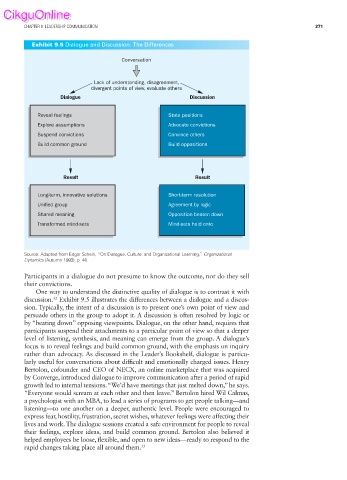
               discussion.  Exhibit 9.5 illustrates the differences between a dialogue and a discus-
                        32
               sion. Typically, the intent of a discussion is to present one’s own point of view and
               persuade others in the group to adopt it. A discussion is often resolved by logic or
               by “beating down” opposing viewpoints. Dialogue, on the other hand, requires that
               participants suspend their attachments to a particular point of view so that a deeper
               level of listening, synthesis, and meaning can emerge from the group. A dialogue’s
               focus is to reveal feelings and build common ground, with the emphasis on inquiry
               rather than advocacy. As discussed in the Leader’s Bookshelf, dialogue is particu-
               larly useful for conversations about difficult and emotionally charged issues. Henry

                 Bertolon, cofounder and CEO of NECX, an online marketplace that was acquired
               by Converge, introduced dialogue to improve communication after a period of rapid
               growth led to internal tensions. “We’d have meetings that just melted down,” he says.
               “Everyone would scream at each other and then leave.” Bertolon hired Wil Calmas,
               a psychologist with an MBA, to lead a series of programs to get people talking—and
               listening—to one another on a deeper, authentic level. People were encouraged to
               express fear, hostility, frustration, secret wishes, whatever feelings were affecting their
               lives and work. The dialogue sessions created a safe environment for people to reveal
               their feelings, explore ideas, and build common ground. Bertolon also believed it
               helped employees be loose, fl exible, and open to new ideas—ready to respond to the
               rapid changes taking place all around them. 33

