


Page 356 - leadership-experience-2008
P. 356
CikguOnline
         CikguOnline
               CHAPTER 11: DEVELOPING LEADERSHIP DIVERSITY                                               337
               Ways Women Lead


               There is some evidence that men may become less influential in the U.S. work-
               force, with women becoming dominant players, because women’s approach is
               more attuned to the needs and values of a multicultural environment. For example,
               there’s a stunning gender reversal in U.S. education, with girls taking over almost
               every leadership role from kindergarten to graduate school. Women of all races
               and ethnic groups are outpacing men in earning bachelor’s and master’s degrees.
                                                                                    48
               In mid-2006, women made up 58 percent of undergraduate college students.
               Among 25- to 29-year-olds, 32 percent of women have college degrees, compared
               to 27 percent of men. Women are rapidly closing the M.D. and Ph.D. gap, and
               they make up about half of all U.S. law students, half of all undergraduate busi-
               ness majors, and about 30 percent of MBA candidates. In addition, studies show
               that women students are more achievement-oriented, less likely to skip classes,
               spend more time studying, and typically earn higher grades.  Overall, women’s
                                                                    49
               participation in both the labor force and civic affairs has steadily increased since
               the mid-1950s, whereas men’s participation has slowly but steadily declined. 50

               Women as Leaders
               According to James Gabarino, an author and professor of human development
               at Cornell University, women are “better able to deliver in terms of what modern
               society requires of people—paying attention, abiding by rules, being verbally
               competent, and dealing with interpersonal relationships in offi ces.”  His obser-
                                                                          51
               vation is supported by the fact that female managers are typically rated higher by
               subordinates on interpersonal skills as well as on factors such as task  behavior,
               communication, ability to motivate others, and goal accomplishment.  As illus-
                                                                            52
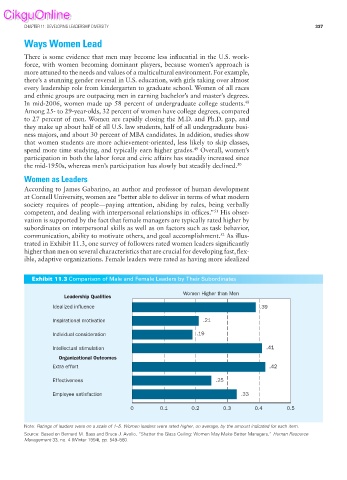
               trated in Exhibit 11.3, one survey of followers rated women leaders  signifi cantly
               higher than men on several characteristics that are crucial for developing fast, fl ex-
               ible, adaptive organizations. Female leaders were rated as having more idealized


                  Exhibit 11.3 Comparison of Male and Female Leaders by Their Subordinates

                                                                Women Higher than Men
                            Leadership Qualities
                        Idealized influence                                             .39
                        Inspirational motivation                       .21

                        Individual consideration                     .19

                        Intellectual stimulation                                          .41
                          Organizational Outcomes
                        Extra effort                                                       .42

                        Effectiveness                                      .25
                        Employee satisfaction                                     .33

                                                0        0.1       0.2       0.3       0.4      0.5


               Note: Ratings of leaders were on a scale of 1–5. Women leaders were rated higher, on average, by the amount indicated for each item.
               Source: Based on Bernard M. Bass and Bruce J. Avolio, “Shatter the Glass Ceiling: Women May Make Better Managers,” Human Resource
               Management 33, no. 4 (Winter 1994), pp. 549–560.

