


Page 30 - PPE GUIDELINE
P. 30
Guidelines on the Use of PPE Against Chemical Hazards
Another recommended method is for the employer to determine the Change Schedule
so that the cartridges or canisters are replaced before the end of their useful life
(service life). In order to determine an appropriate change schedule, the breakthrough
time for the gas or vapour in question must be known or estimated. An appropriate
cartridge/canister change schedule is one that is both convenient and assures that the
concentration of the chemical in the inhaled air does not exceed the exposure limit.
For example, a cartridge may have a breakthrough time of 10 hours for a given
vapour. Changing cartridges at the end of the work shift is usually convenient, and
this period of use is less than the breakthrough time (assuming a 8-hour work shift).
Employers are advised to consult respirator manufacturers for assistance in
determining the service life of a cartridge for a specific chemical and deciding on the
change schedule.
Cleaning
Respirators issued to an individual shall be cleaned regularly. If respirators are shared,
they shall also be cleaned before being worn by different individuals. Respirators
intended for emergency used shall be cleaned after each use.
Users who maintain their own respirators should be trained in cleaning procedures.
Alternatively, a centralized maintenance cleaning and storage station may be used if
there are many routine respirator users.
After removal of any filters or cartridges, the face piece, straps and filter holders
should be washed with mild detergent in warm water using a soft brush, thoroughly
rinsed in clean water and air dried (away from direct sunlight) in a clean place. Rough
handling should be avoided as it may damage the respirator.
Manufacturer’s cleaning and disinfecting method can also be used. Note that some
soaps or detergent may damage the respirator or cause irritation to the user. All
respirators must be thoroughly rinsed after cleaning with detergents.
Storage
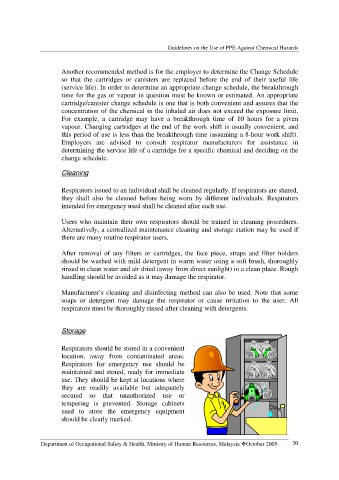
Respirators should be stored in a convenient
location, away from contaminated areas.
Respirators for emergency use should be
maintained and stored, ready for immediate
use. They should be kept at locations where
they are readily available but adequately
secured so that unauthorized use or
tempering is prevented. Storage cabinets
used to store the emergency equipment
should be clearly marked.
Department of Occupational Safety & Health, Ministry of Human Resources, Malaysia October 2005 30

