


Page 33 - PPE GUIDELINE
P. 33
Guidelines on the Use of PPE Against Chemical Hazards
When selecting gloves for chemical protection, it is crucial to determine the type of
chemical the users are exposed to. Always make reference to the Chemical/Material
Safety Data Sheet provided by the chemical manufacturer. Other factors need to
consider include:
a) Contact sequence: this will decide the level of protection, i.e., protection
against accidental splash or continuous contact.
b) Extend of arm exposure: this will determine the length of the glove for
suitable protection coverage.
c) Environmental condition: chemical permeation rate would increase
proportionately under elevated temperature of the chemical.
d) Mechanical hazard presence: this will determine chemical resistant glove with
mechanical protection feature.
Once the above factors are identified,
reference to the chemical to determine the
suitability of the selected gloves. Factors
that determine the resistance of glove
material against the specific chemicals are:
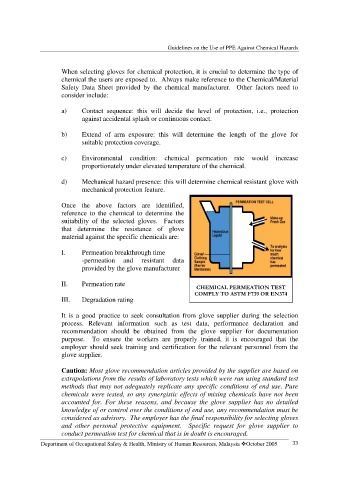
I. Permeation breakthrough time
-permeation and resistant data
provided by the glove manufacturer
II. Permeation rate CHEMICAL PERMEATION TEST
COMPLY TO ASTM F739 OR EN374
III. Degradation rating
It is a good practice to seek consultation from glove supplier during the selection
process. Relevant information such as test data, performance declaration and
recommendation should be obtained from the glove supplier for documentation
purpose. To ensure the workers are properly trained, it is encouraged that the
employer should seek training and certification for the relevant personnel from the
glove supplier.
Caution: Most glove recommendation articles provided by the supplier are based on
extrapolations from the results of laboratory tests which were run using standard test
methods that may not adequately replicate any specific conditions of end use. Pure
chemicals were tested, so any synergistic effects of mixing chemicals have not been
accounted for. For these reasons, and because the glove supplier has no detailed
knowledge of or control over the conditions of end use, any recommendation must be
considered as advisory. The employer has the final responsibility for selecting gloves
and other personal protective equipment. Specific request for glove supplier to
conduct permeation test for chemical that is in doubt is encouraged.
Department of Occupational Safety & Health, Ministry of Human Resources, Malaysia October 2005 33

