


Page 157 - Essentials of Nursing Leadership and Management, 5th Edition
P. 157
CikguOnline
         2208_Ch10_131-156.qxd  11/6/09  5:59 PM  Page 144
               144   unit 2 | Working Within the Organization                                                              CikguOnline
               3. Individuals want different services or have
                  different preferences. Some people choose       Factors Increasing Costs
                  alternative treatment modalities such as
                  acupuncture, herbal therapy, or massage therapy  •  Expansion of national economy
                  rather than traditional health care. Health-care  •  General inflation
                  services are marketed extensively.            •  Aging population
                                                                •  Growth of third-party payments
                                                                •  Employer-provided health insurance
               Regulation and Competition
                                                                •  Tax deduction for medical expenses
               During the past three decades, federal and state
                                                                •  Increased costs of labor and equipment
               governments have attempted to restrain the cost of
                                                                •  Expansion of medical technology
               health care by focusing. Regulation attempts to    and products
               control cost through government actions; competi-  •  Malpractice insurance and litigation
               tion uses market forces. Competition can drive
               aspects of health care through consumers,
               providers, and suppliers. Among the attempts to
               control cost were:                                 Factors Containing Costs
               1. Medicare Prospective Payment System (PPS).  •  Federal economic stabilization program
                  In 1983 the federal government changed its  •  Voluntary effort hospital regulation program
                  method of paying hospitals for treating     •  State-level health-care payment programs
                  Medicare patients. Instead of paying for actual  •  Medicare prospective payment system (PPS)
                  costs, the PPS pays hospitals a fixed, predeter-  with payments of fixed amount per admission
                  mined sum for a particular admission. If a hos-  •  Diagnostic-related groups (DRGs) for
                  pital can provide the service at a cost below the  hospital payments
                  fixed amount, it pockets the difference. If more  •  Resource-based relative value scale (RBRVS)
                  resources and money are used than the prede-  for physician payments
                  termined amount, the hospital incurs a loss.  •  Managed care plans
               2. DRGs. Tied to the PPS, DRGs are the patient
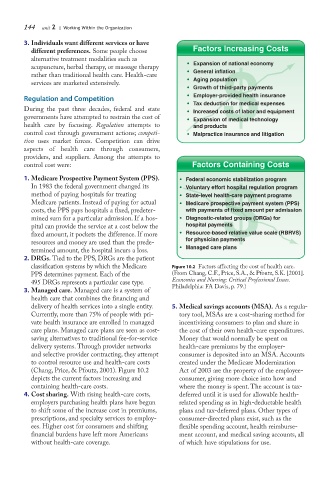
                 classification systems by which the Medicare  Figure 10.2 Factors affecting the cost of health care.
                 PPS determines payment. Each of the        (From Chang, C.F., Price, S.A., & Pfoutz, S.K. [2001].
                 495 DRGs represents a particular case type.  Economics and Nursing: Critical Professional Issues.
                                                            Philadelphia: FA Davis, p. 79.)
               3. Managed care. Managed care is a system of
                  health care that combines the financing and
                  delivery of health services into a single entity.  5. Medical savings accounts (MSA). As a regula-
                  Currently, more than 75% of people with pri-  tory tool, MSAs are a cost-sharing method for
                  vate health insurance are enrolled in managed  incentivizing consumers to plan and share in
                  care plans. Managed care plans are seen as cost-  the cost of their own health-care expenditures.
                  saving alternatives to traditional fee-for-service  Money that would normally be spent on
                  delivery systems. Through provider networks  health-care premiums by the employer-
                  and selective provider contracting, they attempt  consumer is deposited into an MSA. Accounts
                  to control resource use and health-care costs  created under the Medicare Modernization
                  (Chang, Price, & Pfoutz, 2001). Figure 10.2  Act of 2003 are the property of the employee-
                  depicts the current factors increasing and   consumer, giving more choice into how and
                  containing health-care costs.               where the money is spent. The account is tax-
               4. Cost sharing. With rising health-care costs,  deferred until it is used for allowable health-
                  employers purchasing health plans have begun  related spending as in high-deductable health
                  to shift some of the increase cost in premiums,  plans and tax-deferred plans. Other types of
                  prescriptions, and specialty services to employ-  consumer-directed plans exist, such as the
                  ees. Higher cost for consumers and shifting  flexible spending account, health reimburse-
                  financial burdens have left more Americans  ment account, and medical saving accounts, all
                  without health-care coverage.               of which have stipulations for use.

