


Page 159 - Essentials of Nursing Leadership and Management, 5th Edition
P. 159
CikguOnline
         2208_Ch10_131-156.qxd  11/6/09  5:59 PM  Page 146
               146   unit 2 | Working Within the Organization                                                              CikguOnline
                 skilled nursing care. The number of aging baby  staffing, the model of care, and professional
                 boomers will significantly increase the demands  nursing practice (Ritter-Teitel, 2002).
                 on the health-care systems and increase the
                 needs for RNs.                             Safety in the U.S. Health-Care
               ■ Increased demand for nurses. As health care  System
                 moves to a variety of community settings, only
                 the most acute patients remain in the hospital.  Patient safety is the prevention of harm caused by
                 The transfer of less acute patients to nursing  errors. The IOM defines errors as “the failure of a
                 homes and community settings creates addition-  planned action to be completed as intended (e.g.,
                 al job opportunities. Research supporting  error of execution) or the use of a wrong plan to
                 improved patient outcomes when patient care is  achieve an aim (e.g., error of planning) (IOM,
                 provided by RNs as opposed to unlicensed per-  2000, p. 57). It is important to note that errors are
                 sonnel will also increase demand for RNs.  unintentional and that not all errors lead to an
               ■ Aging nursing workforce. In 2000, fewer than  adverse event causing harm or death.
                 one in three RNs was younger than 40 years of
                 age. The percentage of nurses age 40–49 years is  Types of Errors
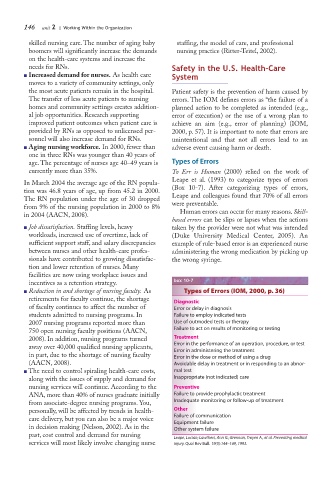
                 currently more than 35%.                   To Err is Human (2000) relied on the work of
                                                            Leape et al. (1993) to categorize types of errors
               In March 2004 the average age of the RN popula-
                                                            (Box 10-7). After categorizing types of errors,
               tion was 46.8 years of age, up from 45.2 in 2000.
                                                            Leape and colleagues found that 70% of all errors
               The RN population under the age of 30 dropped
                                                            were preventable.
               from 9% of the nursing population in 2000 to 8%
                                                              Human errors can occur for many reasons. Skill-
               in 2004 (AACN, 2008).
                                                            based errors can be slips or lapses when the actions
               ■ Job dissatisfaction. Staffing levels, heavy   taken by the provider were not what was intended
                 workloads, increased use of overtime, lack of   (Duke University Medical Center, 2005). An
                 sufficient support staff, and salary discrepancies  example of rule-based error is an experienced nurse
                 between nurses and other health-care profes-  administering the wrong medication by picking up
                 sionals have contributed to growing dissatisfac-  the wrong syringe.
                 tion and lower retention of nurses. Many
                 facilities are now using workplace issues and
                 incentives as a retention strategy.        box 10-7
               ■ Reduction in and shortage of nursing faculty. As  Types of Errors (IOM, 2000, p. 36)
                 retirements for faculty continue, the shortage
                                                            Diagnostic
                 of faculty continues to affect the number of   Error or delay in diagnosis
                 students admitted to nursing programs. In   Failure to employ indicated tests
                 2007 nursing programs reported more than   Use of outmoded tests or therapy
                 750 open nursing faculty positions (AACN,  Failure to act on results of monitoring or testing
                 2008). In addition, nursing programs turned  Treatment
                                                            Error in the performance of an operation, procedure, or test
                 away over 40,000 qualified nursing applicants,
                                                            Error in administering the treatment
                 in part, due to the shortage of nursing faculty  Error in the dose or method of using a drug
                 (AACN, 2008).                              Avoidable delay in treatment or in responding to an abnor-
               ■ The need to control spiraling health-care costs,  mal test
                 along with the issues of supply and demand for  Inappropriate (not indicated) care
                 nursing services will continue. According to the  Preventive
                 ANA, more than 40% of nurses graduate initially  Failure to provide prophylactic treatment
                 from associate-degree nursing programs. You,  Inadequate monitoring or follow-up of treatment
                 personally, will be affected by trends in health-  Other
                                                            Failure of communication
                 care delivery, but you can also be a major voice
                                                            Equipment failure
                 in decision making (Nelson, 2002). As in the  Other system failure
                 past, cost control and demand for nursing
                                                            Leape, Lucian; Lawthers, Ann G.; Brennan, Troyen A., et al. Preventing medical
                 services will most likely involve changing nurse  injury. Qual Rev Bull. 19(5):144–149, 1993.

