


Page 160 - Essentials of Nursing Leadership and Management, 5th Edition
P. 160
CikguOnline
         2208_Ch10_131-156.qxd  11/6/09  5:59 PM  Page 147
                                                                             chapter 10 | Quality and Safety 147           CikguOnline
                   Not all errors lead to patient harm or to an  systems (Rosenthal & Booth, 2005). In addition,
                 adverse event. Each type of event can be studied to  the Food and Drug Administration (FDA) man-
                 glean data used to improve safety.          dates reporting of serious harm or death (adverse
                                                             events) related to drugs and medical devices. Failure
                 ■ Near miss. A near miss is an error that results in
                                                             to report mandatory requirements may lead to fines,
                  no harm or very minimal patient harm (IOM,
                                                             withdrawal of participation in clinical trials, or loss
                  2000, p. 87). Near misses are useful in identify-
                                                             of licensure to operate.
                  ing and remedying vulnerabilities in a system
                                                               The Joint Commission relied on  root cause
                  before harm can occur.
                                                             analysis from each sentinel event. Root cause analy-
                 ■ Adverse event. An adverse event is injury to a
                                                             sis is the process of learning from consequences.
                  patient caused by medical management rather
                                                             The consequences can be desirable, but most root
                  than an underlying condition of the patient
                                                             cause analysis deals with adverse consequences. An
                  (IOM, 2000). The IOM reports have highlight-
                                                             example of a root cause analysis is a review of a
                  ed the prevalence of errors, especially preventa-
                                                             medication error, especially one resulting in a death
                  ble adverse events. Adverse events have been
                                                             or severe complications. Principles of root cause
                  classified into four types (see Box 10-7).
                                                             analysis include:
                 ■ Accident. An accident is an event that involves
                  damage to a defined system that disrupts the  1. Determine what influenced the consequences,
                  ongoing or future output of that system.     i.e., determine the necessary and sufficient
                  Accidents occur when multiple systems fail and  influences that explain the nature and the mag-
                  tend to be unplanned or unforeseen. Accidents  nitude of the consequences.
                  provide information about systems.         2. Establish tightly linked chains of influence.
                                                             3. At every level of analysis, determine the neces-
                 Error Identification and Reporting            sary and sufficient influences.
                                                             4. Whenever feasible, drill down to root causes.
                 Nurses are on the front line in identifying and
                                                             5. Know that there are always multiple root causes.
                 reporting errors. However, many errors are not
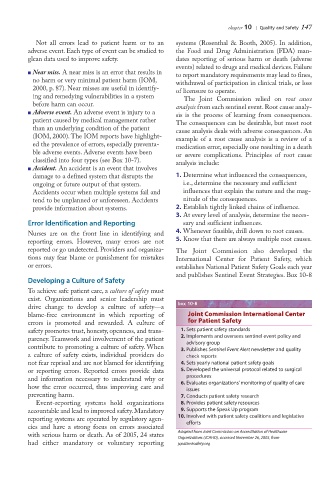
                 reported or go undetected. Providers and organiza-  The Joint Commission also developed the
                 tions may fear blame or punishment for mistakes   International Center for Patient Safety, which
                 or errors.                                  establishes National Patient Safety Goals each year
                                                             and publishes Sentinel Event Strategies. Box 10-8
                 Developing a Culture of Safety
                 To achieve safe patient care, a culture of safety must
                 exist. Organizations and senior leadership must
                                                              box 10-8
                 drive change to develop a culture of safety—a
                 blame-free environment in which reporting of    Joint Commission International Center
                 errors is promoted and rewarded. A culture of   for Patient Safety
                 safety promotes trust, honesty, openness, and trans-  1. Sets patient safety standards
                 parency. Teamwork and involvement of the patient  2. Implements and oversees sentinel event policy and
                                                                advisory group
                 contribute to promoting a culture of safety. When
                                                              3. Publishes Sentinel Event Alert newsletter and quality
                 a culture of safety exists, individual providers do  check reports
                 not fear reprisal and are not blamed for identifying  4. Sets yearly national patient safety goals
                 or reporting errors. Reported errors provide data  5. Developed the universal protocol related to surgical
                 and information necessary to understand why or  procedures
                                                              6. Evaluates organizations’monitoring of quality of care
                 how the error occurred, thus improving care and
                                                                issues
                 preventing harm.                             7. Conducts patient safety research
                   Event-reporting systems hold organizations  8. Provides patient safety resources
                 accountable and lead to improved safety.Mandatory  9. Supports the Speak Up program
                 reporting systems are operated by regulatory agen-  10. Involved with patient safety coalitions and legislative
                                                                efforts
                 cies and have a strong focus on errors associated
                                                              Adapted from Joint Commission on Accreditation of Healthcare
                 with serious harm or death. As of 2005, 24 states
                                                              Organizations (JCAHO), accessed November 26, 2005, from
                 had either mandatory or voluntary reporting   jcpatientsafety.org

