


Page 87 - Essentials of Nursing Leadership and Management, 5th Edition
P. 87
CikguOnline
         2208_Ch06_071-090.qxd  11/6/09  5:57 PM  Page 74
               74   unit 2 | Working Within the Organization                                                               CikguOnline
                 Claude has been working on a busy oncology floor for  It is important for nurses to observe nonverbal
                 several years. He usually has a caseload of six to eight  behavior when communicating with colleagues and
                 patients on his shift, and he believes that he provides  patients and to try to make their own nonverbal
                 safe, competent care.While Claude was on his way to  behavior congruent with their verbal communica-
                 medicate a patient suffering from osteosarcoma, a  tions. Telling people you understand their problem
                 colleague called to him, “Claude, come with me,  when you appear thoroughly confused or inatten-
                 please.” Claude responded, “I need to medicate Mr. J.  tive is an example of incongruence between verbal
                 in Room 203. I will come right after that. Where  and nonverbal communication.
                 will you be?” “Never mind!” his colleague answered.
                 “I’ll find someone who’s more helpful. Don’t ask me  The Basic Listening Sequence
                 for help in the future.” This was not the response
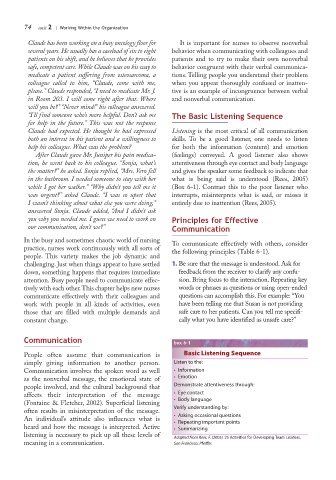
                 Claude had expected. He thought he had expressed  Listening is the most critical of all communication
                 both an interest in his patient and a willingness to  skills. To be a good listener, one needs to listen
                 help his colleague. What was the problem?  for both the information (content) and emotion
                   After Claude gave Mr. Juniper his pain medica-  (feelings) conveyed. A good listener also shows
                 tion, he went back to his colleague. “Sonja, what’s  attentiveness through eye contact and body language
                 the matter?” he asked. Sonja replied, “Mrs. Vero fell  and gives the speaker some feedback to indicate that
                 in the bathroom. I needed someone to stay with her  what is being said is understood (Rees, 2005)
                 while I got her walker.” “Why didn’t you tell me it  (Box 6-1). Contrast this to the poor listener who
                 was urgent?” asked Claude. “I was so upset that   interrupts, misinterprets what is said, or misses it
                 I wasn’t thinking about what else you were doing,”  entirely due to inattention (Rees, 2005).
                 answered Sonja. Claude added, “And I didn’t ask
                 you why you needed me. I guess we need to work on  Principles for Effective
                 our communication, don’t we?”              Communication
               In the busy and sometimes chaotic world of nursing
                                                            To communicate effectively with others, consider
               practice, nurses work continuously with all sorts of
                                                            the following principles (Table 6-1).
               people. This variety makes the job dynamic and
               challenging. Just when things appear to have settled  1. Be sure that the message is understood. Ask for
               down, something happens that requires immediate  feedback from the receiver to clarify any confu-
               attention. Busy people need to communicate effec-  sion. Bring focus to the interaction. Repeating key
               tively with each other.This chapter helps new nurses  words or phrases as questions or using open-ended
               communicate effectively with their colleagues and  questions can accomplish this. For example: “You
               work with people in all kinds of activities, even  have been telling me that Susan is not providing
               those that are filled with multiple demands and  safe care to her patients. Can you tell me specifi-
               constant change.                               cally what you have identified as unsafe care?”


               Communication                                box 6-1

               People often assume that communication is       Basic Listening Sequence
               simply giving information to another person.  Listen to the:
               Communication involves the spoken word as well  • Information
               as the nonverbal message, the emotional state of  • Emotion
               people involved, and the cultural background that  Demonstrate attentiveness through:
               affects their interpretation of the message  • Eye contact
                                                            • Body language
               (Fontaine & Fletcher, 2002). Superficial listening
                                                            Verify understanding by:
               often results in misinterpretation of the message.
                                                            • Asking occasional questions
               An individual’s attitude also influences what is
                                                            • Repeating important points
               heard and how the message is interpreted. Active  • Summarizing
               listening is necessary to pick up all these levels of
                                                            Adapted from Rees, F. (2005). 25 Activities for Developing Team Leaders.
               meaning in a communication.                  San Francisco: Pfeiffer.

