


Page 88 - Essentials of Nursing Leadership and Management, 5th Edition
P. 88
CikguOnline
         2208_Ch06_071-090.qxd  11/6/09  5:57 PM  Page 75
                                                                     chapter 6 | Getting People to Work Together 75        CikguOnline
                 table 6-1                                   is stated clearly and firmly, using  “I” statements.
                                                             For example:
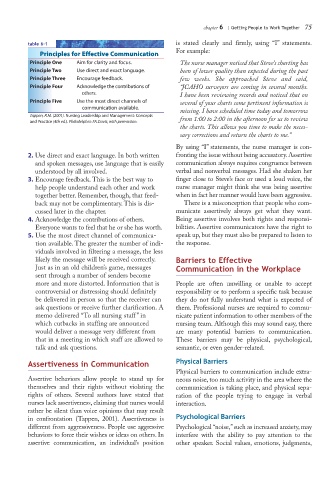
                    Principles for Effective Communication
                 Principle One  Aim for clarity and focus.    The nurse manager noticed that Steve’s charting has
                 Principle Two  Use direct and exact language.  been of lower quality than expected during the past
                 Principle Three  Encourage feedback.         few weeks. She approached Steve and said,
                 Principle Four  Acknowledge the contributions of   “JCAHO surveyors are coming in several months.
                                 others.                      I have been reviewing records and noticed that on
                 Principle Five  Use the most direct channels of   several of your charts some pertinent information is
                                 communication available.
                                                              missing. I have scheduled time today and tomorrow
                 Tappen, R.M. (2001). Nursing Leadership and Management: Concepts
                                                              from 1:00 to 2:00 in the afternoon for us to review
                 and Practice (4th ed.). Philadelphia: FA Davis, with permission.
                                                              the charts. This allows you time to make the neces-
                                                              sary corrections and return the charts to me.”
                                                             By using “I” statements, the nurse manager is con-
                 2. Use direct and exact language. In both written  fronting the issue without being accusatory.Assertive
                   and spoken messages, use language that is easily  communication always requires congruence between
                   understood by all involved.               verbal and nonverbal messages. Had she shaken her
                 3. Encourage feedback. This is the best way to  finger close to Steve’s face or used a loud voice, the
                   help people understand each other and work  nurse manager might think she was being assertive
                   together better. Remember, though, that feed-  when in fact her manner would have been aggressive.
                   back may not be complimentary. This is dis-  There is a misconception that people who com-
                   cussed later in the chapter.              municate assertively always get what they want.
                 4. Acknowledge the contributions of others.  Being assertive involves both rights and responsi-
                   Everyone wants to feel that he or she has worth.  bilities. Assertive communicators have the right to
                 5. Use the most direct channel of communica-  speak up, but they must also be prepared to listen to
                   tion available. The greater the number of indi-  the response.
                   viduals involved in filtering a message, the less
                   likely the message will be received correctly.  Barriers to Effective
                   Just as in an old children’s game, messages  Communication in the Workplace
                   sent through a number of senders become
                   more and more distorted. Information that is  People are often unwilling or unable to accept
                   controversial or distressing should definitely  responsibility or to perform a specific task because
                   be delivered in person so that the receiver can  they do not fully understand what is expected of
                   ask questions or receive further clarification. A  them. Professional nurses are required to commu-
                   memo delivered “To all nursing staff ” in  nicate patient information to other members of the
                   which cutbacks in staffing are announced  nursing team. Although this may sound easy, there
                   would deliver a message very different from  are many potential barriers to communication.
                   that in a meeting in which staff are allowed to  These barriers may be physical, psychological,
                   talk and ask questions.                   semantic, or even gender-related.

                 Assertiveness in Communication              Physical Barriers
                                                             Physical barriers to communication include extra-
                 Assertive behaviors allow people to stand up for  neous noise, too much activity in the area where the
                 themselves and their rights without violating the  communication is taking place, and physical sepa-
                 rights of others. Several authors have stated that  ration of the people trying to engage in verbal
                 nurses lack assertiveness, claiming that nurses would  interaction.
                 rather be silent than voice opinions that may result
                 in confrontation (Tappen, 2001). Assertiveness is  Psychological Barriers
                 different from aggressiveness. People use aggressive  Psychological “noise,”such as increased anxiety, may
                 behaviors to force their wishes or ideas on others. In  interfere with the ability to pay attention to the
                 assertive communication, an individual’s position   other speaker. Social values, emotions, judgments,

