


Page 89 - Essentials of Nursing Leadership and Management, 5th Edition
P. 89
CikguOnline
         2208_Ch06_071-090.qxd  11/6/09  5:57 PM  Page 76
               76   unit 2 | Working Within the Organization                                                               CikguOnline
               and cultural influences also impede communication.  most nurses (Dee, 2005). Additional benefits of
               Previous life experiences and preconceived ideas  computerized systems for health-care applications
               about other cultures also influence how people  are listed in Box 6-2 (Arnold & Pearson, 1992;
               communicate.                                 Hebda, Czar, & Mascara, 1998).
               Semantic Barriers                            E-Mail
               Semantic refers to the meaning of words.     Today, most institutions use e-mail. Using e-mail
               Sometimes, no matter how great the effort, the  competently and effectively requires writing skills;
               message just does not get across.For example,words  the same communication principles apply to both
               such as  neat, cool, and  bad, may convey meanings  e-mail and letter writing. Remember, when com-
               other than those intended. Many individuals have  municating by e-mail, you are not only making an
               learned English as a second language and therefore  impression but also leaving a written record
               understand only the literal meaning of certain  (Shea, 2000).
               words. For example, to many people, cool means  The rules for using e-mail in the workplace are
               interesting, unique, or clever (e.g., “This is a cool  somewhat different than for using e-mail among
               way to find the vein.”). To someone for whom the  friends. Much of the humor and wit found in per-
               word cool refers only to temperature (e.g., “It is cool  sonal e-mail is not appropriate for the work setting.
               outside.”), the preceding statement would make  Professional e-mail may remain informal.
               very little sense.                           However, the message must be clear, concise, and
                                                            courteous.Think about what you need to say before
               Gender Barriers                              you write it. Then write it, read it, and reread it.
               Men and women develop dissimilar communication  Once you are satisfied that the message is clear and
               skills and are inclined to communicate differently.  concise, send it.
               Often, they give different meanings to conveyed  Many executives read personal e-mail sent to
               information or feelings. This may be related to   them, which means that it is often possible to
               psychosocial development.Boys learn to use commu-  contact them directly. Many systems make it easy
               nication as a way to negotiate and to develop inde-  to send e-mail to everyone at the health-care
               pendence, whereas girls use communication to con-  institution. For this reason, it is important to
               firm, minimize disparities, and create or strengthen  keep e-mail professional. Remember the  “chain
               closeness (Blais, Hayes, Kozier, & Erb, 2002).  of command”: always go through the proper
                                                            channels.
                                                              The fact that you have the capability to send
               Communication With Colleagues                e-mail instantly to large groups of people does not
                                                            necessarily make sending it a good idea. Be careful
               Information Systems and E-Mail
                                                            if you have access to an all-company mailing list. It
               Computerized Systems                         is easy to send an e-mail throughout the system
               Communication through the use of computer tech-
               nology is rapidly growing in nursing practice. A
               study conducted by KPMG–Peat Marwick of
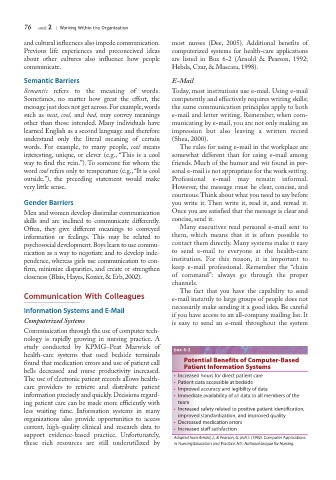
                                                            box 6-2
               health-care systems that used bedside terminals
                                                               Potential Benefits of Computer-Based
               found that medication errors and use of patient call
                                                               Patient Information Systems
               bells decreased and nurse productivity increased.
                                                            • Increased hours for direct patient care
               The use of electronic patient records allows health-
                                                            • Patient data accessible at bedside
               care providers to retrieve and distribute patient  • Improved accuracy and legibility of data
               information precisely and quickly.Decisions regard-  • Immediate availability of all data to all members of the
               ing patient care can be made more efficiently with  team
               less waiting time. Information systems in many  • Increased safety related to positive patient identification,
                                                              improved standardization, and improved quality
               organizations also provide opportunities to access
                                                            • Decreased medication errors
               current, high-quality clinical and research data to  • Increased staff satisfaction
               support evidence-based practice. Unfortunately,
                                                            Adapted from Arnold, J., & Pearson, G. (eds.). (1992). Computer Applications
               these rich resources are still underutilized by   in Nursing Education and Practice. N.Y.: National League for Nursing.

