


Page 133 - ANUAL REPORT MOH 2017
P. 133
ADOLESCENT HEALTH SERVICES                                                                                                                          Figure 34
                                                                                                                             Number of New Antenatal Cases Age Specific Fertility Rate (ASFR) among adolescent
             Adolescent Health Programme was established in 1996 as one of the expanded scope of Family
             Health Development Division (FHDD). This program aims to develop and strengthen health services                                                girls 15 to 19 years
             for the adolescent population. In 2017, the total adolescent population (10-19 years) is 5,452,400 or
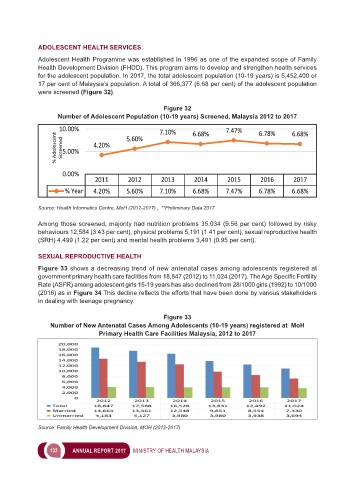
             17 per cent of Malaysia’s population. A total of 366,377 (6.68 per cent) of the adolescent population
             were screened (Figure 32).

                                                     Figure 32
                   Number of Adolescent Population (10-19 years) Screened, Malaysia 2012 to 2017

                    10.00%                          7.10%      6.68%     7.47%      6.78%     6.68%
                   % Adolescent   Screened  5.00%  4.20%  5.60%


                     0.00%
                               2011       2012      2013       2014       2015      2016       2017
                      % Year   4.20%     5.60%      7.10%      6.68%     7.47%      6.78%     6.68%
                                                                                                                         Source: Department of Statistics, Malaysia, 2016

             Source: Health Informatics Centre, MoH (2012-2017) ,  **Preliminary Data 2017                               The issue of teenage pregnancy was brought up in multiple national level platforms such as the
                                                                                                                         National Social Council; State Ministers/Chief Ministers Meetings chaired by Deputy Prime Minister
             Among those screened, majority had nutrition problems 35,034 (9.56 per cent) followed by risky              as well as 240  Council of Rulers Conference. DYMM Raja Zarith Sofiah Binti Almarhum Sultan Idris
                                                                                                                                      th
             behaviours 12,584 (3.43 per cent), physical problems 5,191 (1.41 per cent), sexual reproductive health      Shah officiated the Ministry of Health launch of the ‘Generasiku Sayang’ Programme (GKS) in 2015,
             (SRH) 4,499 (1.22 per cent) and mental health problems 3,491 (0.95 per cent).                               an initiative to create awareness and commitment among the public and relevant agencies to work
                                                                                                                         together in addressing the issue of teenage pregnancy.
             SEXUAL REPRODUCTIVE HEALTH

             Figure 33 shows a decreasing trend of new antenatal cases among adolescents registered at                   Currently, Johor and Kelantan have established the ‘Pusat Generasiku Sayang’, while Sarawak has
             government primary health care facilities from 18,847 (2012) to 11,024 (2017). The Age Specific Fertility   developed ‘One Stop Teenage Pregnancy Committee’ (OSTPC). Perlis, Pulau Pinang, Kedah, Perak,
             Rate (ASFR) among adolescent girls 15-19 years has also declined from 28/1000 girls (1992) to 10/1000       Pahang, Selangor, Melaka and Sabah have integrated the GKS concept in existing institutions under
             (2016) as in Figure 34 This decline reflects the efforts that have been done by various stakeholders        the Social Welfare Department or private NGOs.
             in dealing with teenage pregnancy.
                                                                                                                         In 2017 a second national video competition was held to tap the young minds on SRH related matters.
                                                     Figure 33                                                           This topic was divided into 3 scopes, in which 70.5 per cent submissions were on Cybersex; 22.4 per
                 Number of New Antenatal Cases Among Adolescents (10-19 years) registered at  MoH                        cent were on Gender and Sexuality and 16.3 per cent were on Reproductive Health. The winning videos
                                 Primary Health Care Facilities Malaysia, 2012 to 2017                                   were uploaded and shared in MoH websites, FHDD Youtube channel and Facebook page. MoH has
                                                                                                                         established a National Technical Committee on Adolescent Health chaired by Deputy Director General
                                                                                                                         Public Health to monitor implementation of the National Adolescent Health Policy and Plan of Action
                                                                                                                         2016-2020 (NAHPOA).


                                                                                                                         ADULT HEALTH SERVICES
                                                                                                                         Health services for adult since 2009 focus on comprehensive and tailored health risk screening for
                                                                                                                         earlier detection of diseases and risk factors to facilitate earlier treatment and intervention. Health
                                                                                                                         screening is implemented in every health clinic and the target for this activity has been set at 5 percent
                                                                                                                         of all total adult population aged 20-59 years. Coverage for screening activity for 2017 is currently still
                                                                                                                         below target at 4.7 per cent for women and 3.6 per cent for adult male. Figures 35 and 36 describe
             Source: Family Health Development Division, MOH (2012-2017)                                                 the health risks detected in men and women respectively for the past 3 years.


                 132    ANNUAL REPORT 2017     MINISTRY OF HEALTH MALAYSIA

