


Page 131 - ANUAL REPORT MOH 2017
P. 131
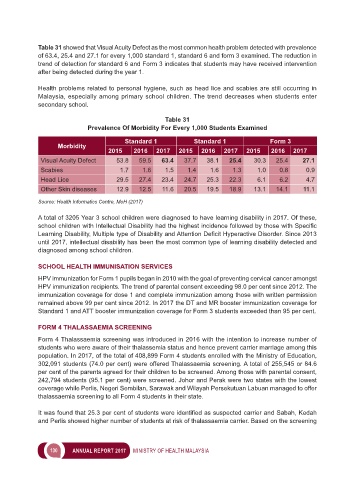
Table 31 showed that Visual Acuity Defect as the most common health problem detected with prevalence
             of 63.4, 25.4 and 27.1 for every 1,000 standard 1, standard 6 and form 3 examined. The reduction in
             trend of detection for standard 6 and Form 3 indicates that students may have received intervention
             after being detected during the year 1.

             Health problems related to personal hygiene, such as head lice and scabies are still occurring in
             Malaysia, especially among primary school children. The trend decreases when students enter
             secondary school.

                                                      Table 31
                             Prevalence Of Morbidity For Every 1,000 Students Examined
                                         Standard 1            Standard 1              Form 3
                    Morbidity
                                    2015    2016   2017   2015   2016    2017   2015    2016   2017
              Visual Acuity Defect    53.8   59.5    63.4   37.7   38.1   25.4    30.3   25.4     27.1
              Scabies                  1.7     1.6    1.5    1.4    1.6    1.3     1.0    0.8      0.9
              Head Lice               29.5   27.4    23.4   24.7   25.3   22.3     6.1    6.2      4.7
              Other Skin diseases     12.9   12.5    11.6   20.5   19.5   18.9    13.1   14.1     11.1

             Source: Health Informatics Centre, MoH (2017)
             A total of 3205 Year 3 school children were diagnosed to have learning disability in 2017. Of these,
             school children with Intellectual Disability had the highest incidence followed by those with Specific
             Learning Disability, Multiple type of Disability and Attention Deficit Hyperactive Disorder. Since 2013
             until 2017, intellectual disability has been the most common type of learning disability detected and
             diagnosed among school children.

             SCHOOL HEALTH IMMUNISATION SERVICES

             HPV immunization for Form 1 pupils began in 2010 with the goal of preventing cervical cancer amongst
             HPV immunization recipients. The trend of parental consent exceeding 98.0 per cent since 2012. The
             immunization coverage for dose 1 and complete immunization among those with written permission
             remained above 99 per cent since 2012. In 2017 the DT and MR booster immunization coverage for
             Standard 1 and ATT booster immunization coverage for Form 3 students exceeded than 95 per cent.

             FORM 4 THALASSAEMIA SCREENING

             Form 4 Thalassaemia screening was introduced in 2016 with the intention to increase number of
             students who were aware of their thalassemia status and hence prevent carrier marriage among this
             population. In 2017, of the total of 408,899 Form 4 students enrolled with the Ministry of Education,
             302,091 students (74.0 per cent) were offered Thalassaemia screening. A total of 255,545 or 84.6
             per cent of the parents agreed for their children to be screened. Among those with parental consent,
             242,794 students (95.1 per cent) were screened. Johor and Perak were two states with the lowest
             coverage while Perlis, Negeri Sembilan, Sarawak and Wilayah Persekutuan Labuan managed to offer
             thalassaemia screening to all Form 4 students in their state.

             It was found that 25.3 per cent of students were identified as suspected carrier and Sabah, Kedah
             and Perlis showed higher number of students at risk of thalassaemia carrier. Based on the screening


                 130    ANNUAL REPORT 2017     MINISTRY OF HEALTH MALAYSIA

