


Page 347 - ANUAL REPORT MOH 2017
P. 347
•   GAP EQUIPMENT SUPPLY STATUS
             Under the agreement, QMS is also responsible to supply, deliver, install, testing and commissioning of
             GAP equipment. The procurement of the GAP equipment is divided into two (2) types, which are New
             Biomedical Equipment (NBE) and Purchased Biomedical Equipment (PBE). For NBE, the equipment
             will be leased out to the Government for a period of 8 years after which the equipment ownership is
             belonging to the Government. For PBE, the Government will own the equipment after it has been
             supplied.  All of the equipment will be supplied in 12 batches within a 3 years period.


             The supply of GAP equipment has been started on September to November 2016 for batch 1, December
             2016 to February 2017 for batch 2, March to May 2017 for batch 3, June to August 2017 for batch 4
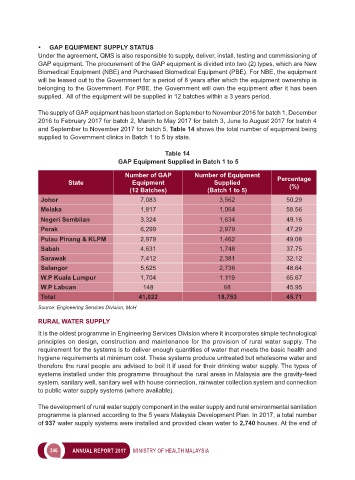
             and September to November 2017 for batch 5. Table 14 shows the total number of equipment being
             supplied to Government clinics in Batch 1 to 5 by state.


                                                      Table 14
                                       GAP Equipment Supplied in Batch 1 to 5

                                         Number of GAP         Number of Equipment
                       State               Equipment                 Supplied             Percentage
                                                                                             (%)
                                          (12 Batches)             (Batch 1 to 5)
              Johor                           7,083                    3,562                50.29
              Melaka                          1,817                    1,064                58.56
              Negeri Sembilan                 3,324                    1,634                49.16
              Perak                           6,299                    2,979                47.29
              Pulau Pinang & KLPM             2,979                    1,462                49.08
              Sabah                           4,631                    1,748                37.75
              Sarawak                         7,412                    2,381                32.12
              Selangor                        5,625                    2,736                48.64
              W.P Kuala Lumpur                1,704                    1,119                65.67
              W.P Labuan                       148                      68                  45.95
              Total                          41,022                    18,753               45.71

             Source: Engineering Services Division, MoH
             RURAL WATER SUPPLY

             It is the oldest programme in Engineering Services Division where it incorporates simple technological
             principles on design, construction and maintenance for the provision of rural water supply. The
             requirement for the systems is to deliver enough quantities of water that meets the basic health and
             hygiene requirements at minimum cost. These systems produce untreated but wholesome water and
             therefore the rural people are advised to boil it if used for their drinking water supply. The types of
             systems installed under this programme throughout the rural areas in Malaysia are the gravity-feed
             system, sanitary well, sanitary well with house connection, rainwater collection system and connection
             to public water supply systems (where available).

             The development of rural water supply component in the water supply and rural environmental sanitation
             programme is planned according to the 5 years Malaysia Development Plan. In 2017, a total number
             of 937 water supply systems were installed and provided clean water to 2,740 houses. At the end of


                 346    ANNUAL REPORT 2017     MINISTRY OF HEALTH MALAYSIA

