


Page 123 - alligood 8th edition_Neat
P. 123
104    UNIT II  Nursing Philosophies

           and economic structures occupied a larger dimen-  nurse-patient relationship. Qualitatively different sys-
           sion  to  illustrate  their  increasing  influence  on  the   tems, such as political, economic, social-cultural, and
           nature  of  institutional  caring  (Ray,  1981a).  Subse-  physiological, when viewed as open and interactive,
           quent research conducted in intensive care and in-  are  whole  and  operate  through  the  choice  making
           termediate  care  units  (Ray,  1989)  emphasized  the   of nurses (Davidson & Ray, 1991; Ray, 1994a). Spiri-
           differential  nature  of  caring,  as  seen  through  its   tual-ethical  caring  suggests  how  choice  making  for
           competing  structures  of  political,  legal,  economic,   the  good  of  others  can  be  accomplished  in  nursing
           technological-physiological, spiritual-religious, eth-  practice.
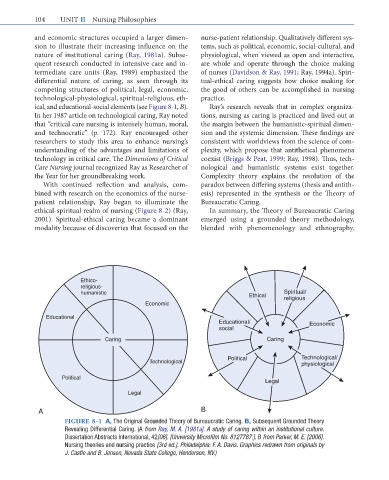
           ical, and educational-social elements (see Figure 8-1, B).   Ray’s  research  reveals  that  in  complex  organiza-
           In her 1987 article on technological caring, Ray noted   tions, nursing as caring is practiced and lived out at
           that “critical care nursing is intensely human, moral,   the margin between the humanistic-spiritual dimen-
           and  technocratic”  (p.  172).  Ray  encouraged  other    sion and the systemic dimension. These findings are
           researchers  to  study  this  area  to  enhance  nursing’s   consistent with worldviews from the science of com-
           understanding  of  the  advantages  and  limitations  of   plexity,  which  propose  that  antithetical  phenomena
           technology in critical care. The Dimensions of Critical   coexist (Briggs & Peat, 1999; Ray, 1998). Thus, tech-
           Care Nursing journal recognized Ray as Researcher of   nological  and  humanistic  systems  exist  together.
           the Year for her groundbreaking work.         Complexity  theory  explains  the  resolution  of  the
             With  continued  reflection  and  analysis,  com-  paradox between differing systems (thesis and antith-
           bined with research on the economics of the nurse-  esis)  represented  in  the  synthesis  or  the  Theory  of
           patient  relationship,  Ray  began  to  illuminate  the   Bureaucratic Caring.
           ethical-spiritual realm of nursing (Figure 8-2) (Ray,   In summary, the Theory of Bureaucratic Caring
           2001).  Spiritual-ethical  caring  became  a  dominant   emerged  using  a  grounded  theory  methodology,
           modality because of discoveries that focused on the   blended  with  phenomenology  and  ethnography.


                       Ethico-
                       religious-
                       humanistic                                     Ethical   Spiritual/
                                                                                religious
                                         Economic
              Educational
                                                              Educational/             Economic
                                                              social
                              Caring                                       Caring


                                                                Political            Technological/
                                           Technological                             physiological
                  Political
                                                                           Legal
                                     Legal

            A                                            B
                   FIGURE 8-1   A, The Original Grounded Theory of Bureaucratic Caring. B, Subsequent Grounded Theory
                   Revealing Differential Caring. (A from Ray, M. A. [1981a]. A study of caring within an institutional culture.
                   Dissertation Abstracts International, 42[06]. [University Microfilm No. 8127787.]. B from Parker, M. E. [2006].
                   Nursing theories and nursing practice [3rd ed.]. Philadelphia: F. A. Davis. Graphics redrawn from originals by
                   J. Castle and B. Jensen, Nevada State College, Henderson, NV.)

