


Page 129 - alligood 8th edition_Neat
P. 129
110    UNIT II  Nursing Philosophies

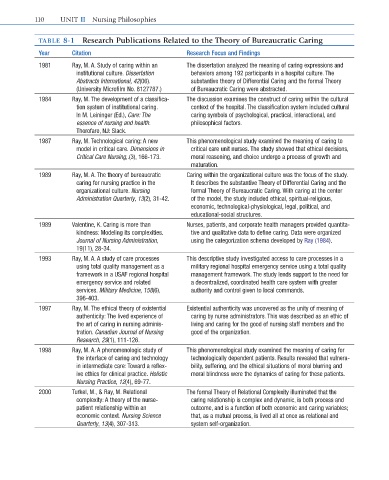
            TABLE 8-1  Research Publications Related to the Theory of Bureaucratic Caring
            Year     Citation                        Research Focus and Findings

            1981     Ray, M. A. Study of caring within an    The dissertation analyzed the meaning of caring expressions and
                      institutional culture. Dissertation   behaviors among 192 participants in a hospital culture. The
                      Abstracts International, 42(06).   substantive theory of Differential Caring and the formal Theory
                      (University Microfilm No. 8127787.)  of Bureaucratic Caring were abstracted.
            1984     Ray, M. The development of a classifica-  The discussion examines the construct of caring within the cultural
                      tion system of institutional caring.    context of the hospital. The classification system included cultural
                      In M. Leininger (Ed.), Care: The   caring symbols of psychological, practical, interactional, and
                      essence of nursing and health.   philosophical factors.
                      Thorofare, NJ: Slack.
            1987     Ray, M. Technological caring: A new   This phenomenological study examined the meaning of caring to
                      model in critical care. Dimensions in   critical care unit nurses. The study showed that ethical decisions,
                      Critical Care Nursing,.(3), 166-173.  moral reasoning, and choice undergo a process of growth and
                                                      maturation.
            1989     Ray, M. A. The theory of bureaucratic   Caring within the organizational culture was the focus of the study.
                      caring for nursing practice in the    It describes the substantive Theory of Differential Caring and the
                      organizational culture. Nursing   formal Theory of Bureaucratic Caring. With caring at the center
                      Administration Quarterly, 13(2), 31-42.  of the model, the study included ethical, spiritual-religious,
                                                      economic, technological-physiological, legal, political, and
                                                      educational-social structures.
            1989     Valentine, K. Caring is more than    Nurses, patients, and corporate health managers provided quantita-
                      kindness: Modeling its complexities.   tive and qualitative data to define caring. Data were organized
                      Journal of Nursing Administration,   using the categorization schema developed by Ray (1984).
                      19(11), 28-34.
            1993     Ray, M. A. A study of care processes    This descriptive study investigated access to care processes in a
                      using total quality management as a   military regional hospital emergency service using a total quality
                      framework in a USAF regional hospital   management framework. The study lends support to the need for
                      emergency service and related    a decentralized, coordinated health care system with greater
                      services. Military Medicine, 158(6),   authority and control given to local commands.
                      396-403.
            1997     Ray, M. The ethical theory of existential   Existential authenticity was uncovered as the unity of meaning of
                      authenticity: The lived experience of   caring by nurse administrators. This was described as an ethic of
                      the art of caring in nursing adminis-  living and caring for the good of nursing staff members and the
                      tration. Canadian Journal of Nursing   good of the organization.
                      Research, 29(1), 111-126.
            1998     Ray, M. A. A phenomenologic study of   This phenomenological study examined the meaning of caring for
                      the interface of caring and technology   technologically dependent patients. Results revealed that vulnera-
                      in intermediate care: Toward a reflex-  bility, suffering, and the ethical situations of moral blurring and
                      ive ethics for clinical practice. Holistic   moral blindness were the dynamics of caring for these patients.
                      Nursing Practice, 12(4), 69-77.
            2000     Turkel, M., & Ray, M. Relational    The formal Theory of Relational Complexity illuminated that the
                      complexity: A theory of the nurse-   caring relationship is complex and dynamic, is both process and
                      patient relationship within an    outcome, and is a function of both economic and caring variables;
                      economic context. Nursing Science   that, as a mutual process, is lived all at once as relational and
                      Quarterly, 13(4), 307-313.      system self-organization.

