


Page 130 - alligood 8th edition_Neat
P. 130
CHAPTER 8  Marilyn Anne Ray  111

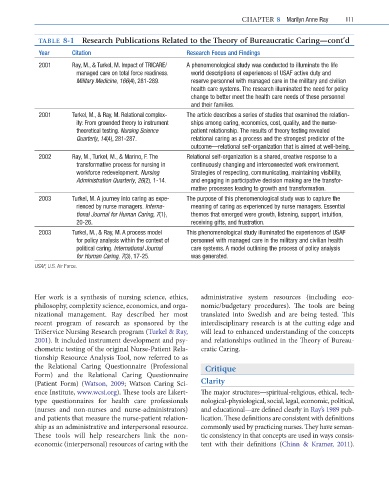
            TABLE 8-1  Research Publications Related to the Theory of Bureaucratic Caring—cont’d
            Year     Citation                        Research Focus and Findings

            2001     Ray, M., & Turkel, M. Impact of TRICARE/  A phenomenological study was conducted to illuminate the life
                      managed care on total force readiness.   world descriptions of experiences of USAF active duty and
                      Military Medicine, 166(4), 281-289.  reserve personnel with managed care in the military and civilian
                                                      health care systems. The research illuminated the need for policy
                                                      change to better meet the health care needs of these personnel
                                                      and their families.
            2001     Turkel, M., & Ray, M. Relational complex-  The article describes a series of studies that examined the relation-
                      ity: From grounded theory to instrument   ships among caring, economics, cost, quality, and the nurse-
                      theoretical testing. Nursing Science   patient relationship. The results of theory testing revealed
                      Quarterly, 14(4), 281-287.      relational caring as a process and the strongest predictor of the
                                                      outcome—relational self-organization that is aimed at well-being.
            2002     Ray, M., Turkel, M., & Marino, F. The   Relational self-organization is a shared, creative response to a
                      transformative process for nursing in   continuously changing and interconnected work environment.
                      workforce redevelopment. Nursing   Strategies of respecting, communicating, maintaining visibility,
                      Administration Quarterly, 26(2), 1-14.  and engaging in participative decision making are the transfor-
                                                      mative processes leading to growth and transformation.
            2003     Turkel, M. A journey into caring as expe-  The purpose of this phenomenological study was to capture the
                      rienced by nurse managers. Interna-  meaning of caring as experienced by nurse managers. Essential
                      tional Journal for Human Caring, 7(1),   themes that emerged were growth, listening, support, intuition,
                      20-26.                          receiving gifts, and frustration.
            2003     Turkel, M., & Ray, M. A process model   This phenomenological study illuminated the experiences of USAF
                      for policy analysis within the context of   personnel with managed care in the military and civilian health
                      political caring. International Journal   care systems. A model outlining the process of policy analysis
                      for Human Caring, 7(3), 17-25.  was generated.
           USAF, U.S. Air Force.


           Her  work  is  a  synthesis  of  nursing  science,  ethics,   administrative  system  resources  (including  eco-
           philosophy, complexity science, economics, and orga-  nomic/budgetary  procedures).  The  tools  are  being
           nizational  management.  Ray  described  her  most    translated  into  Swedish  and  are  being  tested.  This
           recent  program  of  research  as  sponsored  by  the   interdisciplinary research is at the cutting edge and
           TriService Nursing Research program (Turkel & Ray,   will lead to enhanced understanding of the concepts
           2001). It included instrument development and psy-  and relationships outlined in the Theory of Bureau-
           chometric testing of the original Nurse-Patient Rela-  cratic Caring.
           tionship Resource Analysis Tool, now referred to as
           the  Relational  Caring  Questionnaire  (Professional   Critique
           Form)  and  the  Relational  Caring  Questionnaire
           (Patient  Form)  (Watson,  2009;  Watson  Caring  Sci-  Clarity
           ence Institute, www.wcsi.org). These tools are Likert-  The major structures—spiritual-religious, ethical, tech-
           type  questionnaires  for  health  care  professionals   nological-physiological, social, legal, economic, political,
           (nurses  and  non-nurses  and  nurse-administrators)   and educational—are defined clearly in Ray’s 1989 pub-
           and patients that measure the nurse-patient relation-  lication. These definitions are consistent with definitions
           ship as an administrative and interpersonal resource.   commonly used by practicing nurses. They have seman-
           These  tools  will  help  researchers  link  the  non-   tic consistency in that concepts are used in ways consis-
           economic (interpersonal) resources of caring with the   tent  with  their  definitions  (Chinn  &  Kramer,  2011).

