


Page 327 - alligood 8th edition_Neat
P. 327
308    UNIT III  Nursing Conceptual Models

            Use of Empirical Evidence                     Major Assumptions

           From  this  beginning,  the  Roy  Adaptation  Model  has   Assumptions from systems theory and assumptions
           been  supported  through  research  in  practice  and  in   from  adaptation  level  theory  have  been  combined
           education (Brower & Baker, 1976; Farkas, 1981; Mastal   into  a  single  set  of  scientific  assumptions.  From
           & Hammond, 1980; Meleis, 1985, 2007; Roy, 1980; Roy   systems theory, human adaptive systems are viewed
           &  Obloy,  1978;  Wagner,  1976).  In  1999  (Roy  &   as interactive parts that act in unity for some pur-
           Andrews, 1999), a group of seven scholars working with   pose.  Human  adaptive  systems  are  complex  and
           Roy conducted a meta-analysis, critique, and synthesis   multifaceted and respond to a myriad of environ-
           of 163 studies based on the Roy Adaptation Model that   mental  stimuli  to  achieve  adaptation.  With  their
           had been published in 44 English language journals on   ability  to  adapt  to  environmental  stimuli,  humans
           five continents and dissertations and theses from the   have the capacity to create changes in the environ-
           United States. Of these 163 studies, 116 met the criteria   ment (Roy & Andrews, 1999). Drawing on charac-
           established  for  testing  propositions  from  the  model.   teristics  of  creation  spirituality  by  Swimme  and
           Twelve generic propositions based on Roy’s earlier work   Berry  (1992),  Roy  combined  the  assumptions  of
           were  derived.  To  synthesize  the  research,  findings  of   humanism and veritivity into a single set of philo-
           each  study  were  used  to  state  ancillary  and  practice   sophical  assumptions.  Humanism  asserts  that  the
           propositions,  and  support  for  the  propositions  was    person  and  human  experiences  are  essential  to
           examined. Of 265 propositions tested, 216 (82%) were   knowing and valuing, and that they share in creative
           supported.  Roy  (2011a)  presented  a  comprehensive   power. Veritivity affirms the belief in the purpose,
           review of research based on the adaptation model for   value, and meaning of all human life. These scientific
           the last 25 years in Nursing Science Quarterly, volume   and  philosophical  assumptions  have  been  refined
           24, number 4. The complete issue is dedicated to honor-  for  use  of  the  model  in  the  twenty-first  century
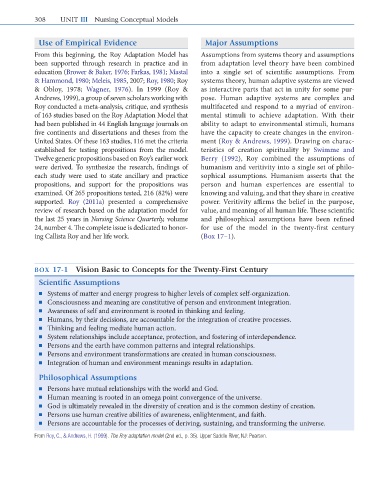
           ing Callista Roy and her life work.           (Box 17–1).


           BOX 17-1  Vision Basic to Concepts for the Twenty-First Century
            Scientific Assumptions
            n	 Systems of matter and energy progress to higher levels of complex self-organization.
            n	 Consciousness and meaning are constitutive of person and environment integration.
            n	 Awareness of self and environment is rooted in thinking and feeling.
            n	 Humans, by their decisions, are accountable for the integration of creative processes.
            n	 Thinking and feeling mediate human action.
            n	 System relationships include acceptance, protection, and fostering of interdependence.
            n	 Persons and the earth have common patterns and integral relationships.
            n	 Persons and environment transformations are created in human consciousness.
            n	 Integration of human and environment meanings results in adaptation.

            Philosophical Assumptions
            n	 Persons have mutual relationships with the world and God.
            n	 Human meaning is rooted in an omega point convergence of the universe.
            n	 God is ultimately revealed in the diversity of creation and is the common destiny of creation.
            n	 Persons use human creative abilities of awareness, enlightenment, and faith.
            n	 Persons are accountable for the processes of deriving, sustaining, and transforming the universe.

           From Roy, C., & Andrews, H. (1999). The Roy adaptation model (2nd ed., p. 35). Upper Saddle River, NJ: Pearson.

