


Page 329 - alligood 8th edition_Neat
P. 329
310    UNIT III  Nursing Conceptual Models

             Health  and  illness  is  one  inevitable,  coexistent    ineffective response. Adaptive responses promote integ-
           dimension of the person’s total life experience (Riehl   rity and help the person to achieve the goals of adapta-
           & Roy, 1980). Nursing is concerned with this dimen-  tion, that is, they achieve survival, growth, reproduction,
           sion.  When  mechanisms  for  coping  are  ineffective,   mastery,  and  person  and  environmental  transforma-
           illness is the result. Health ensues when humans con-  tions. Ineffective responses fail to achieve or threaten the
           tinually  adapt.  As  people  adapt  to  stimuli,  they  are   goals of adaptation. Nursing has a unique goal to assist
           free to respond to other stimuli. The freeing of energy   the person’s adaptation effort by managing the environ-
           from ineffective coping attempts can promote healing   ment.  The  result  is  attainment  of  an  optimal  level  of
           and enhance health (Roy, 1984).               wellness by the person (Andrews & Roy, 1986; Randell,
                                                         Tedrow,  &  Van  Landingham,  1982;  Roy,  1970,  1971,
           Environment                                   1980, 1984; Roy & Roberts, 1981).
           According to Roy, environment is “all the conditions,   As  an  open  living  system,  the  person  receives
           circumstances, and influences surrounding and affect-  inputs  or  stimuli  from  both  the  environment  and
           ing the development and behavior of persons or groups,   the  self.  The  adaptation  level  is  determined  by  the
           with particular consideration of the mutuality of person   combined  effect  of  focal,  contextual,  and  residual
           and earth resources that includes focal, contextual, and   stimuli. Adaptation occurs when the person responds
           residual stimuli” (Roy & Andrews, 1999, p. 81). “It is the   positively  to  environmental  changes.  This  adaptive
           changing environment [that] stimulates the person to   response promotes the integrity of the person, which
           make adaptive responses” (Andrews & Roy, 1991, p. 18).   leads to health. Ineffective responses to stimuli lead to
           Environment is the input into the person as an adaptive   disruption of the integrity of the person (Andrews &
           system  involving  both  internal  and  external  factors.   Roy,  1986;  Randell,  Tedrow,  &  Van  Landingham,
           These factors may be slight or large, negative or posi-  1982; Roy, 1970, 1971, 1980; Roy & McLeod, 1981).
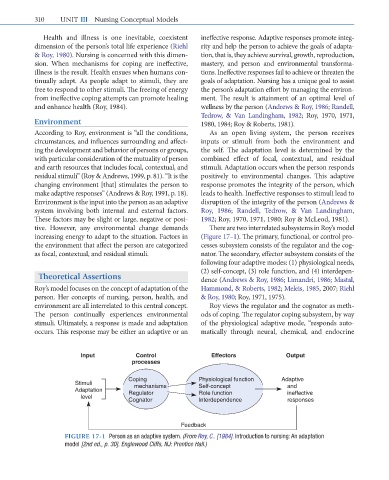
           tive.  However,  any  environmental  change  demands   There are two interrelated subsystems in Roy’s model
           increasing energy to adapt to the situation. Factors in   (Figure 17–1). The primary, functional, or control pro-
           the environment that affect the person are categorized   cesses subsystem consists of the regulator and the cog-
           as focal, contextual, and residual stimuli.   nator. The secondary, effector subsystem consists of the
                                                         following four adaptive modes: (1) physiological needs,
                                                         (2) self-concept, (3) role function, and (4) interdepen-
            Theoretical Assertions                       dence (Andrews & Roy, 1986; Limandri, 1986; Mastal,
           Roy’s model focuses on the concept of adaptation of the   Hammond, & Roberts, 1982; Meleis, 1985, 2007; Riehl
           person.  Her  concepts  of  nursing,  person,  health,  and   & Roy, 1980; Roy, 1971, 1975).
           environment are all interrelated to this central concept.   Roy views the regulator and the cognator as meth-
           The  person  continually  experiences  environmental   ods of coping. The regulator coping subsystem, by way
           stimuli. Ultimately, a response is made and adaptation   of  the  physiological  adaptive  mode,  “responds  auto-
           occurs. This response may be either an adaptive or an   matically  through  neural,  chemical,  and  endocrine


                       Input           Control              Effectors           Output
                                      processes

                                     Coping             Physiological function   Adaptive
                      Stimuli         mechanisms        Self-concept             and
                      Adaptation     Regulator          Role function            ineffective
                       level
                                     Cognator           Interdependence          responses


                                                   Feedback
                   FIGURE 17-1   Person as an adaptive system. (From Roy, C.. [1984]. Introduction to nursing: An adaptation
                   model [2nd ed., p. 30]. Englewood Cliffs, NJ: Prentice Hall.)

