


Page 330 - alligood 8th edition_Neat
P. 330
CHAPTER 17  Sister Callista Roy  311

           coping processes” (Andrews & Roy, 1991, p. 14). The
           cognator coping subsystem, by way of the self-concept,         HUMAN SYSTEMS
           interdependence,  and  role  function  adaptive  modes,
           “responds  through  four  cognitive-emotive  channels:   PHYSIOLOGICAL-   SELF-
           perceptual information processing, learning, judgment,   STIMULI   PHYSICAL   CONCEPT–
           and emotion” (Andrews & Roy, 1991, p. 14). Perception                    GROUP
           is the interpretation of a stimulus, and perception links                 IDENTITY
           the regulator with the cognator in that “input into the           COPING
           regulator  is  transformed  into  perceptions.  Perception      PROCESSES
           is  a  process  of  the  cognator.  The  responses  following                BEHAVIOR
           perception are feedback into both the cognator and the   INTERDEPENDENCE
           regulator” (Galligan, 1979, p. 67).                                     ROLE
             The four adaptive modes of the two subsystems in                    FUNCTION
           Roy’s model provide form or manifestations of cognator
                                                                                        BEHAVIOR
           and regulator activity. Responses to stimuli are carried        ADAPTATION
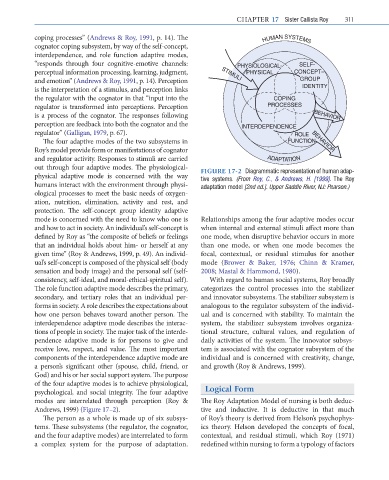
           out  through  four  adaptive  modes.  The  physiological-  FIGURE 17-2   Diagrammatic representation of human adap-
           physical  adaptive  mode  is  concerned  with  the  way    tive  systems.  (From  Roy,  C.,  &  Andrews,  H.  [1999].  The  Roy
           humans interact with the environment through physi-  adaptation model [2nd ed.]. Upper Saddle River, NJ: Pearson.)
           ological processes to meet the basic needs of oxygen-
           ation,  nutrition,  elimination,  activity  and  rest,  and
           protection.  The  self-concept  group  identity  adaptive
           mode is concerned with the need to know who one is   Relationships among the four adaptive modes occur
           and how to act in society. An individual’s self-concept is   when internal and external stimuli affect more than
           defined by Roy as “the composite of beliefs or feelings   one mode, when disruptive behavior occurs in more
           that an individual holds about him- or herself at any   than  one  mode,  or  when  one  mode  becomes  the
           given time” (Roy & Andrews, 1999, p. 49). An individ-  focal,  contextual,  or  residual  stimulus  for  another
           ual’s self-concept is composed of the physical self (body   mode  (Brower  &  Baker,  1976;  Chinn  &  Kramer,
           sensation and body image) and the personal self (self-  2008; Mastal & Hammond, 1980).
           consistency, self-ideal, and moral-ethical-spiritual self).   With regard to human social systems, Roy broadly
           The role function adaptive mode describes the primary,   categorizes  the  control  processes  into  the  stabilizer
           secondary,  and  tertiary  roles  that  an  individual  per-  and innovator subsystems. The stabilizer subsystem is
           forms in society. A role describes the expectations about   analogous to the regulator subsystem of the individ-
           how one person behaves toward another person. The    ual and is concerned with stability. To maintain the
           interdependence adaptive mode describes the interac-  system,  the  stabilizer  subsystem  involves  organiza-
           tions of people in society. The major task of the interde-  tional  structure,  cultural  values,  and  regulation  of
           pendence  adaptive  mode  is  for  persons  to  give  and    daily activities of the system. The innovator subsys-
           receive  love,  respect,  and  value.  The  most  important   tem is associated with the cognator subsystem of the
           components of the interdependence adaptive mode are   individual and is concerned with creativity, change,
           a  person’s  significant  other  (spouse,  child,  friend,  or   and growth (Roy & Andrews, 1999).
           God) and his or her social support system. The purpose
           of the four adaptive modes is to achieve physiological,
           psychological,  and  social  integrity.  The  four  adaptive   Logical Form
           modes  are  interrelated  through  perception  (Roy  &    The Roy Adaptation Model of nursing is both deduc-
           Andrews, 1999) (Figure 17–2).                 tive  and  inductive.  It  is  deductive  in  that  much
             The person as a whole is made up of six subsys-  of Roy’s theory is derived from Helson’s psychophys-
           tems. These subsystems (the regulator, the cognator,   ics  theory.  Helson  developed  the  concepts  of  focal,
           and the four adaptive modes) are interrelated to form   contextual,  and  residual  stimuli,  which  Roy  (1971)
           a  complex  system  for  the  purpose  of  adaptation.    redefined within nursing to form a typology of factors

