


Page 57 - alligood 8th edition_Neat
P. 57
4

           CHAP TER


                                            The Structure of Specialized

                                                            Nursing Knowledge


                                                                         Martha Raile Alligood


              his chapter presents the structure for specialized   TABLE 4-1   Knowledge Structure Levels
           Tnursing knowledge used for the organization of            with Examples
           the units of this text. As presented in Chapter 1, the
           requirement for a body of specialized knowledge for   Structure Level  Example
           recognition of nursing as a profession was a driving   Metaparadigm  Person, environment, health, and nursing
           force in the twentieth century. Because of the impor-
           tance  of  nurses  to  the  nation’s  health,  early  in  the   Philosophy  Nightingale
           twentieth  century,  studies  of  nursing  were  legislated   Conceptual   Neuman’s systems model
           and conducted by sociologists who recommended that   models
           nursing be developed as a profession. The criteria for a   Theory  Neuman’s theory of optimal client stability
           profession provided guidance in this process (Bixler &   Middle-range   Maintaining optimal client stability with
           Bixler, 1959; Kalish & Kalish, 2003). The criterion that   theory  structured activity (body recall) in a
           called for specialized nursing knowledge and knowl-          community setting for healthy aging
           edge  structure  was  a  particularly  important  driving   Modified from Alligood, M. R. (2010). Nursing theory: Utilization & applica-
           force in recognition of nursing as a profession (Bixler   tion  (4th  ed.).  St.  Louis:  Mosby;  and  Fawcett,  J.  (2005).  Contemporary
           & Bixler, 1959). The criterion reads:         nursing  knowledge:  Conceptual  models  of  nursing  and  nursing  theories
                                                         (2nd ed.). Philadelphia: F. A. Davis.
             Utilizes  in  its  practice  a  well-defined  and  well-
             organized  body  of  specialized  knowledge  [that]     logical  presentation.  Early  works  that  predate  the
             is on the intellectual level of the higher learning   nursing theory era, such as Nightingale (1969/1859),
             (p. 1143).
                                                         contributed to knowledge development by providing
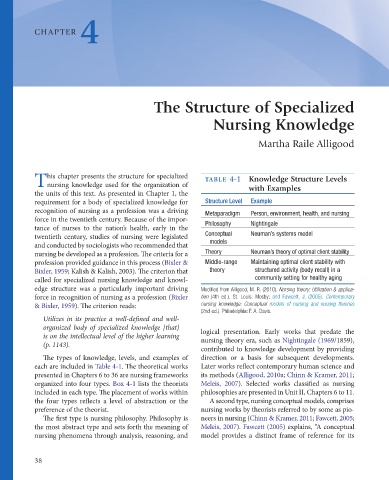
             The  types  of  knowledge,  levels,  and  examples  of   direction  or  a  basis  for  subsequent  developments.
           each are included in Table 4-1. The theoretical works   Later works reflect contemporary human science and
           presented in Chapters 6 to 36 are nursing frameworks   its methods (Alligood, 2010a; Chinn & Kramer, 2011;
           organized into four types. Box 4-1 lists the theorists   Meleis,  2007).  Selected  works  classified  as  nursing
           included in each type. The placement of works within   philosophies are presented in Unit II, Chapters 6 to 11.
           the  four  types  reflects  a  level  of  abstraction  or  the   A second type, nursing conceptual models, comprises
           preference of the theorist.                   nursing works by theorists referred to by some as pio-
             The first type is nursing philosophy. Philosophy is   neers in nursing (Chinn & Kramer, 2011; Fawcett, 2005;
           the most abstract type and sets forth the meaning of   Meleis, 2007). Fawcett (2005) explains, “A conceptual
           nursing phenomena through analysis, reasoning, and   model  provides  a  distinct  frame  of  reference  for  its


           38

