


Page 574 - alligood 8th edition_Neat
P. 574
28

                                                                             CHAP TER


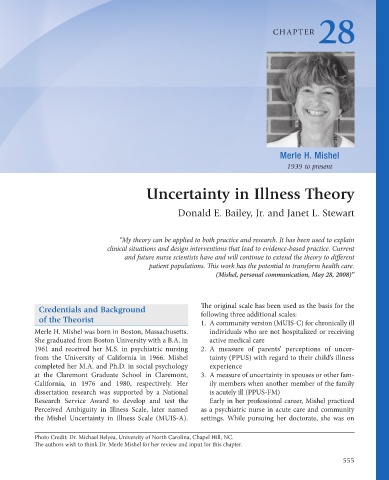
                                                                               Merle H. Mishel
                                                                                 1939 to present


                                          Uncertainty in Illness Theory


                                                  Donald E. Bailey, Jr. and Janet L. Stewart


                                  “My theory can be applied to both practice and research. It has been used to explain
                               clinical situations and design interventions that lead to evidence-based practice. Current
                                    and future nurse scientists have and will continue to extend the theory to different
                                          patient populations. This work has the potential to transform health care.
                                                             (Mishel, personal communication, May 28, 2008)”


                                                         The original scale has been used as the basis for the
            Credentials and Background                   following three additional scales:
            of the Theorist                                1.  A community version (MUIS-C) for chronically ill
           Merle H. Mishel was born in Boston, Massachusetts.   individuals who are not hospitalized or receiving
           She graduated from Boston University with a B.A. in   active medical care
           1961  and  received  her  M.S.  in  psychiatric  nursing     2.  A  measure  of  parents’  perceptions  of  uncer-
           from  the  University  of  California  in  1966.  Mishel   tainty (PPUS) with regard to their child’s illness
           completed her M.A. and Ph.D. in social psychology   experience
           at  the  Claremont  Graduate  School  in  Claremont,     3.  A measure of uncertainty in spouses or other fam-
           California,  in  1976  and  1980,  respectively.  Her    ily members when another member of the family
           dissertation  research  was  supported  by  a  National   is acutely ill (PPUS-FM)
           Research  Service  Award  to  develop  and  test  the    Early in her professional career, Mishel practiced
           Perceived  Ambiguity  in  Illness  Scale,  later  named    as a psychiatric nurse in acute care and community
           the  Mishel  Uncertainty  in  Illness  Scale  (MUIS-A).   settings.  While  pursuing  her  doctorate,  she  was  on

           Photo Credit: Dr. Michael Belyea, University of North Carolina, Chapel Hill, NC.
           The authors wish to think Dr. Merle Mishel for her review and input for this chapter.

                                                                                                555

