


Page 578 - alligood 8th edition_Neat
P. 578
CHAPTER 28  Merle H. Mishel  559

           Sorenson, 1991; Page, Fedele, Pai, et al., 2012; Schepp,   studies of people with chronic and life-threatening ill-
           1991; Wineman, 1990), quality of life (Lasker, Sogolow,   nesses. The process of formulating a new view of life is
           Short, et al., 2011; Somjaivong Thanasilp, Preechawong,   described  by  women  with  breast  cancer  and  cardiac
           et  al.,  2011;  Song,  Northouse,  Braun,  et  al.,  2011),   disease as a revised life perspective (Hilton, 1988), new
           satisfaction with family relationships (Wineman, O’Brien,   life goals (Carter, 1993), new ways of being in the world
           Nealon,  et  al.,  1993),  satisfaction  with  health  care   (Mast, 1998; Nelson, 1996), growth through uncertainty
           services  (Green  &  Murton,  1996;  Tai-Seale,  Stults,   (Pelusi,  1997),  and  new  levels  of  self-organization
           Zhang, et al., 2012), and family caregivers’ maintenance   (Fleury,  Kimbrell,  &  Kruszewski,  1995).  In  studies  of
           of their own self-care activities (Brett & Davies, 1988;   men with chronic illness or their caregivers, the pro-
           O’Brien, Wineman, & Nealon, 1995).            cess is described as transformed self-identity and new
             In 1990, the original theory was expanded to in-  goals for living (Brown & Powell-Cope, 1991), a more
           clude the idea that uncertainty may not be resolved   positive perspective on life (Katz, 1996), reevaluating
           but may become part of an individual’s reality. In this   what is worthwhile (Nyhlin, 1990), contemplation and
           context,  uncertainty  is  appraised  as  an  opportunity   self-appraisal (Charmaz, 1995), uncertainty viewed as
           that  prompts  the  formation  of  a  new,  probabilistic   opportunity (Baier, 1995), and redefining normal and
           view of life. To adopt this new view of life, the patient   building new dreams (Mishel & Murdaugh, 1987).
           must be able to rely on social resources and health
           care  providers  who  themselves  accept  the  idea  of   Major Assumptions
           probabilistic  thinking  (Mishel,  1990).  When  uncer-
           tainty is framed as a normal part of life, it becomes a   Person
           positive force for multiple opportunities and resulting   Mishel’s  Uncertainty  in  Illness  Theory  is  middle-
           positive mood states (Gelatt, 1989; Mishel, 1990).  range  and  focused  on  persons.  Mishel’s  original
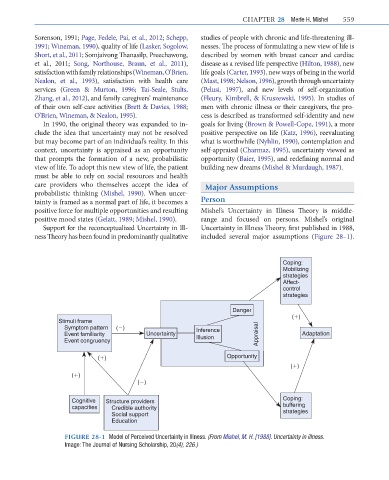
             Support for the reconceptualized Uncertainty in Ill-  Uncertainty in Illness Theory, first published in 1988,
           ness Theory has been found in predominantly qualitative   included  several  major  assumptions  (Figure  28–1).


                                                                                Coping:
                                                                                Mobilizing
                                                                                strategies
                                                                                Affect-
                                                                                control
                                                                                strategies
                                                                  Danger
                                                                                  ( )
                 Stimuli frame
                   Symptom pattern  ( )                 Inference
                   Event familiarity      Uncertainty   Illusion         Appraisal   Adaptation
                   Event congruency


                            ( )                                 Opportunity
                                                                                  ( )
                     ( )
                                       ( )

                     Cognitive  Structure providers                             Coping:
                     capacities    Credible authority                           buffering
                                Social support                                  strategies
                                Education

                   FIGURE 28-1   Model of Perceived Uncertainty in Illness. (From Mishel, M. H. [1988]. Uncertainty in illness.
                   Image: The Journal of Nursing Scholarship, 20(4), 226.)

