


Page 579 - alligood 8th edition_Neat
P. 579
560    UNIT V  Middle Range Nursing Theories

           The first two reflect how uncertainty was conceptual-  •  Fluctuations result in repatterning, which is repeated
           ized within psychology’s information-processing mod-  at each level of the system.
           els, as follows:                                In  Mishel’s  reconceptualized  theory,  neither  the
             1.  Uncertainty  is  a  cognitive  state,  representing  the   antecedents to uncertainty nor the process of cogni-
             inadequacy of an existing cognitive schema to sup-  tive appraisal of uncertainty as danger or opportunity
             port the interpretation of illness-related events.  change.  However,  uncertainty  over  time,  associated
             2.  Uncertainty  is  an  inherently  neutral  experience,   with a serious illness, functions as a catalyst for fluc-
             neither desirable nor aversive until it is appraised   tuation in the system by threatening one’s preexisting
             as such.                                    cognitive model of life as predictable and controllable.
             Two more assumptions reflect the uncertainty the-  Because uncertainty pervades nearly every aspect of
           ory’s  roots  in  traditional  stress  and  coping  models   a  person’s  life,  its  effects  become  concentrated  and
           that  posit  a  linear  stress  A  coping  A  adaptation   ultimately challenge the stability of the system. In re-
           relationship as follows:                      sponse to the confusion and disorganization created
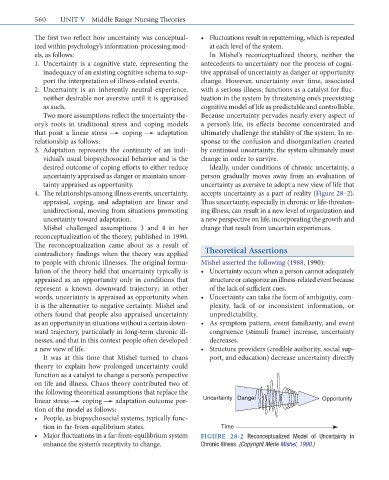
            3.  Adaptation  represents  the  continuity  of  an  indi-  by continued uncertainty, the system ultimately must
             vidual’s usual biopsychosocial behavior and is the   change in order to survive.
             desired outcome of coping efforts to either reduce   Ideally, under conditions of chronic uncertainty, a
             uncertainty appraised as danger or maintain uncer-  person  gradually  moves  away  from  an  evaluation  of
             tainty appraised as opportunity.            uncertainty as aversive to adopt a new view of life that
            4.  The relationships among illness events, uncertainty,   accepts uncertainty as a part of reality (Figure 28–2).
             appraisal,  coping,  and  adaptation  are  linear  and   Thus uncertainty, especially in chronic or life-threaten-
             unidirectional, moving from situations promoting   ing illness, can result in a new level of organization and
             uncertainty toward adaptation.              a new perspective on life, incorporating the growth and
             Mishel  challenged  assumptions  3  and  4  in  her   change that result from uncertain experiences.
           reconceptualization of the theory, published in 1990.
           The  reconceptualization  came  about  as  a  result  of
           contradictory findings when the theory was applied   Theoretical Assertions
           to people with chronic illnesses. The original formu-  Mishel asserted the following (1988, 1990):
           lation of the theory held that uncertainty typically is   •  Uncertainty occurs when a person cannot adequately
           appraised as an opportunity only in conditions that   structure or categorize an illness-related event because
           represent  a  known  downward  trajectory;  in  other   of the lack of sufficient cues.
           words, uncertainty is appraised as opportunity when   •  Uncertainty can take the form of ambiguity, com-
           it is the alternative to negative certainty. Mishel and   plexity,  lack  of  or  inconsistent  information,  or
           others found that people also appraised uncertainty    unpredictability.
           as an opportunity in situations without a certain down-  •  As symptom pattern, event familiarity, and event
           ward trajectory, particularly in long-term chronic ill-  congruence  (stimuli  frame)  increase,  uncertainty
           nesses, and that in this context people often developed   decreases.
           a new view of life.                           •  Structure providers (credible authority, social sup-
             It  was  at  this  time  that  Mishel  turned  to  chaos   port, and education) decrease uncertainty directly
           theory  to  explain  how  prolonged  uncertainty  could
           function as a catalyst to change a person’s perspective
           on life and illness. Chaos theory contributed two of
           the following theoretical assumptions that replace the
           linear stress A coping A adaptation outcome por-  Uncertainty Danger           Opportunity
           tion of the model as follows:
           •  People, as biopsychosocial systems, typically func-
             tion in far-from-equilibrium states.             Time
           •  Major fluctuations in a far-from-equilibrium system   FIGURE  28-2   Reconceptualized  Model  of  Uncertainty  in
             enhance the system’s receptivity to change.  Chronic Illness. (Copyright Merle Mishel, 1990.)

