


Page 20 - MGPI_Case_Study
P. 20
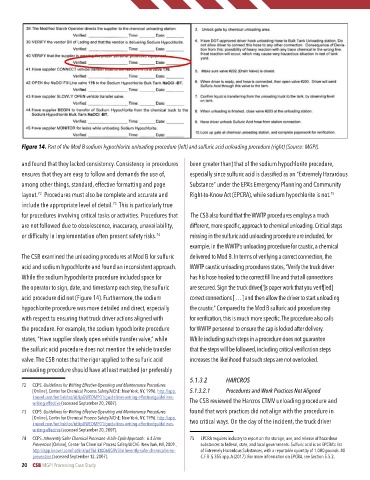
Figure 14. Part of the Mod B sodium hypochlorite unloading procedure (left) and sulfuric acid unloading procedure (right) (Source: MGPI).

        and found that they lacked consistency. Consistency in procedures   been greater than) that of the sodium hypochlorite procedure,
        ensures that they are easy to follow and demands the use of,   especially since sulfuric acid is classified as an “Extremely Hazardous

        among other things, standard, effective formatting and page   Substance” under the EPA’s Emergency Planning and Community
                                                                                                              75
              72
        layout.   Procedures must also be complete and accurate and   Right-to-Know Act (EPCRA), while sodium hypochlorite is not.
                                      73
        include the appropriate level of detail.   This is particularly true
        for procedures involving critical tasks or activities. Procedures that    The CSB also found that the WWTP procedures employs a much
        are not followed due to obsolescence, inaccuracy, unavailability,   different, more specific, approach to chemical unloading. Critical steps
                                                     74
        or difficulty in implementation often present safety risks.     missing in the sulfuric acid unloading procedure are included, for
                                                                example, in the WWTP’s unloading procedure for caustic, a chemical
        The CSB examined the unloading procedures at Mod B for sulfuric   delivered to Mod B. In terms of verifying a correct connection, the
        acid and sodium hypochlorite and found an inconsistent approach.   WWTP caustic unloading procedures states, “Verify the truck driver

        While the sodium hypochlorite procedure included space for   has his hose hooked to the correct fill line and that all connections
        the operator to sign, date, and timestamp each step, the sulfuric   are secured. Sign the truck driver[’]s paper work that you verif[ied]
        acid procedure did not (Figure 14). Furthermore, the sodium   correct connections [ . . . ] and then allow the driver to start unloading
        hypochlorite procedure was more detailed and direct, especially   the caustic.” Compared to the Mod B sulfuric acid procedure step
        with respect to ensuring that truck driver actions aligned with   for verification, this is much more specific. The procedure also calls
        the procedure. For example, the sodium hypochlorite procedure   for WWTP personnel to ensure the cap is locked after delivery.
        states, “Have supplier slowly open vehicle transfer valve,” while   While including such steps in a procedure does not guarantee

        the sulfuric acid procedure does not mention the vehicle transfer   that the steps will be followed, including critical verification steps
        valve. The CSB notes that the rigor applied to the sulfuric acid   increases the likelihood that such steps are not overlooked.
        unloading procedure should have at least matched (or preferably
                                                                5.1.3.2     HARCROS
        72  CCPS. Guidelines for Writing Effective Operating and Maintenance Procedures
            [Online], Center for Chemical Process Safety/AIChE: New York, NY, 1996. http://app.  5.1.3.2.1   Procedures and Work Practices Not Aligned
            knovel.com/hotlink/toc/id:kpGWEOMP01/guidelines-writing-effective/guidelines-
            writing-effective (accessed September 20, 2007).    The CSB reviewed the Harcros CTMV unloading procedure and
        73  CCPS. Guidelines for Writing Effective Operating and Maintenance Procedures   found that work practices did not align with the procedure in
            [Online], Center for Chemical Process Safety/AIChE: New York, NY, 1996. http://app.
            knovel.com/hotlink/toc/id:kpGWEOMP01/guidelines-writing-effective/guidelines-  two critical ways. On the day of the incident, the truck driver
            writing-effective (accessed September 20, 2007).
        74  CCPS. Inherently Safer Chemical Processes--A Life Cycle Approach:  6.4 Error   75   EPCRA requires industry to report on the storage, use, and release of hazardous
            Prevention [Online], Center for Chemical Process Safety/AIChE: New York, NY, 2009.   substances to federal, state, and local governments. Sulfuric acid is on EPCRA’s list
            http://app.knovel.com/hotlink/pdf/id:kt0068GRV3/inherently-safer-chemical/error-  of Extremely Hazardous Substances, with a reportable quantity of 1,000 pounds. 40
            prevention (accessed September 12, 2007).              C.F.R. § 355 app. A (2017). For more information on EPCRA, see Section 5.5.2.
        20  CSB MGPI Processing Case Study

