


Page 21 - MGPI_Case_Study
P. 21
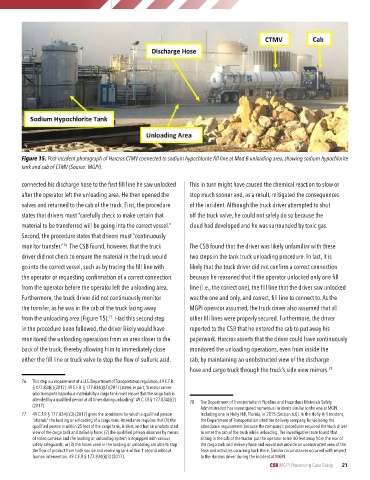
Figure 15. Post-incident photograph of Harcros CTMV connected to sodium hypochlorite fill line at Mod B unloading area, showing sodium hypochlorite
        tank and cab of CTMV (Source: MGPI).


        connected his discharge hose to the first fill line he saw unlocked   This in turn might have caused the chemical reaction to slow or
        after the operator left the unloading area. He then opened the   stop much sooner and, as a result, mitigated the consequences
        valves and returned to the cab of the truck. First, the procedure   of the incident. Although the truck driver attempted to shut
        states that drivers must “carefully check to make certain that   off the truck valve, he could not safely do so because the
        material to be transferred will be going into the correct vessel.”   cloud had developed and he was surrounded by toxic gas.
        Second, the procedure states that drivers must “continuously
                      76
        monitor transfer.”   The CSB found, however, that the truck   The CSB found that the driver was likely unfamiliar with these
        driver did not check to ensure the material in the truck would   two steps in the tank truck unloading procedure. In fact, it is
        go into the correct vessel, such as by tracing the fill line with   likely that the truck driver did not confirm a correct connection

        the operator or requesting confirmation of a correct connection   because he reasoned that if the operator unlocked only one fill
        from the operator before the operator left the unloading area.   line (i.e., the correct one), the fill line that the driver saw unlocked
        Furthermore, the truck driver did not continuously monitor   was the one and only, and correct, fill line to connect to. As the
        the transfer, as he was in the cab of the truck facing away   MGPI operator assumed, the truck driver also assumed that all
                                     77
        from the unloading area (Figure 15).   Had this second step   other fill lines were properly secured. Furthermore, the driver
        in the procedure been followed, the driver likely would have   reported to the CSB that he entered the cab to put away his
        monitored the unloading operations from an area closer to the   paperwork. Harcros asserts that the driver could have continuously

        back of the truck, thereby allowing him to immediately close   monitored the unloading operations, even from inside the
        either the fill line or truck valve to stop the flow of sulfuric acid.   cab, by maintaining an unobstructed view of the discharge
                                                                hose and cargo truck through the truck’s side view mirrors.
                                                                                                              78
        76   This step is a requirement of a U.S. Department of Transportation regulation, 49 C.F.R.
            § 177.834(i) (2017). 49 C.F.R. § 177.834(i)(2) (2017) states, in part, “A motor carrier
            who transports hazardous materials by a cargo tank must ensure that the cargo tank is
            attended by a qualified person at all times during unloading.” 49 C.F.R § 177.834(i)(2)   78   The Department of Transportation’s Pipeline and Hazardous Materials Safety
            (2017).
                                                                   Administration has investigated numerous incidents similar to the one at MGPI,
        77   49 C.F.R § 177.834(i)(3) (2017) gives the conditions for which a qualified person   including one in Holly Hill, Florida, in 2015 (Section 6.0). In the Holly Hill incident,
            “attends” the loading or unloading of a cargo tank. Attendance requires that (1) the   the Department of Transportation cited the delivery company for violating the
            qualified person is within 25 feet of the cargo tank, is alert, and has an unobstructed   attendance requirement because the company’s procedures required the truck driver
            view of the cargo tank and delivery hose; (2) the qualified person observes by means   to enter the cab of the truck while unloading. The investigative team found that
            of video cameras and the loading or unloading system is equipped with various   sitting in the cab of the tractor put the operator some 40 feet away from the rear of
            safety safeguards; or (3) the hoses used in the loading or unloading are able to stop   the cargo tank and delivery hose and would not provide an unobstructed view of the
            the flow of product from both source and receiving tank within 1 second without   hose and activities occurring back there. Similar circumstances occurred with respect
            human intervention. 49 C.F.R § 177.834(i)(3) (2017).   to the Harcros driver during the incident at MGPI.
                                                                                          CSB MGPI Processing Case Study   21

