


Page 16 - MGPI_Case_Study
P. 16
receives four chemicals   via CTMV about 200 feet from the
                                                                                  54
                                                                Mod B transfer area, uses a different padlock and key for each fill
                                                                line.   Using different padlocks and keys for each valve prevents
                                                                   55
                                                                operators from unlocking the incorrect valve with another key.


                                                                5.1.2   PIPE MARKING
                                                                Pipe markings, labels, and tags are extremely important in
                                                                process plants and all facilities that handle hazardous chemicals

                                                                to ensure that workers can identify equipment that requires
                                                                                                manipulation and to
                                                                 Pipe markings on               communicate hazards

                                                                 transfer equipment             that cannot be controlled
                                                                 and piping should be           by other means. Proper

                                                                 accurate and legible.          equipment identification
                                                                                                reduces errors of
                                                                 Pipe markers should            commission   with
                                                                                                         56
                                                                 be placed as close to          using the wrong piece of
                                                                 the fill line as possible      equipment or performing


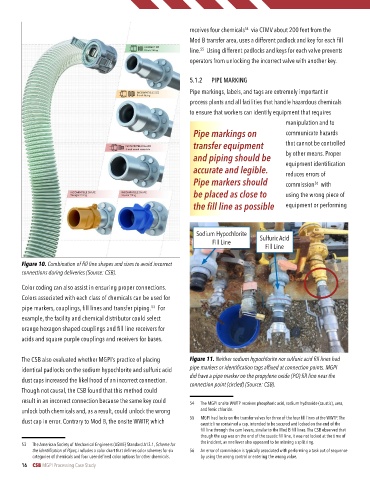
                                                                  Sodium Hypochlorite
                                                                                       Sulfuric Acid
                                                                       Fill Line
                                                                                         Fill Line

        Figure 10. Combination of fill line shapes and sizes to avoid incorrect
        connections during deliveries (Source: CSB).


        Color coding can also assist in ensuring proper connections.
        Colors associated with each class of chemicals can be used for
                                                   53
        pipe markers, couplings, fill lines and transfer piping.   For
        example, the facility and chemical distributor could select
        orange hexagon shaped couplings and fill line receivers for
        acids and square purple couplings and receivers for bases.


        The CSB also evaluated whether MGPI’s practice of placing   Figure 11. Neither sodium hypochlorite nor sulfuric acid fill lines had
                                                                pipe markers or identification tags affixed at connection points. MGPI
        identical padlocks on the sodium hypochlorite and sulfuric acid
                                                                did have a pipe marker on the propylene oxide (PO) fill line near the
        dust caps increased the likelihood of an incorrect connection.
                                                                connection point (circled) (Source: CSB).
        Though not causal, the CSB found that this method could
        result in an incorrect connection because the same key could   54   The MGPI onsite WWTP receives phosphoric acid, sodium hydroxide (caustic), urea,
        unlock both chemicals and, as a result, could unlock the wrong   and ferric chloride.
                                                                55   MGPI had locks on the transfer valves for three of the four fill lines at the WWTP. The
        dust cap in error. Contrary to Mod B, the onsite WWTP, which   caustic line contained a cap, intended to be secured and locked on the end of the
                                                                   fill line through the cam levers, similar to the Mod B fill lines. The CSB observed that
                                                                   though the cap was on the end of the caustic fill line, it was not locked at the time of
        53   The American Society of Mechanical Engineers (ASME) Standard A13.1, Scheme for   the incident, as one lever also appeared to be missing a split ring.
            the Identification of Pipes, includes a color chart that defines color schemes for six   56   An error of commission is typically associated with performing a task out of sequence
            categories of chemicals and four user-defined color options for other chemicals.  by using the wrong control or entering the wrong value.
        16  CSB MGPI Processing Case Study

