


Page 22 - MGPI_Case_Study
P. 22
5.1.3.2.2   Training

        The CSB also examined Harcros’ training program and determined
        that it was deficient in effectively communicating the importance
        of the critical safety steps that did not align with work practices
        on the day of the incident. As part of its training program, Harcros
        requires drivers to complete various tasks included on a tanker
        training log; the driver’s trainer must observe and initial that
        they have been completed. Two of these tasks include ensuring

        “customer’s piping is to the correct storage vessel” and “constant
        monitoring of the connections and tanker during the unloading
        process to abate leaks or any other malfunction that might
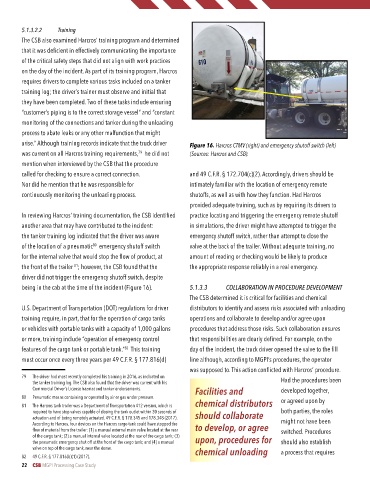
        arise.” Although training records indicate that the truck driver   Figure 16. Harcros CTMV (right) and emergency shutoff switch (left)
                                               79
        was current on all Harcros training requirements,   he did not   (Sources: Harcros and CSB).
        mention when interviewed by the CSB that the procedure
        called for checking to ensure a correct connection.     and 49 C.F.R. § 172.704(c)(2). Accordingly, drivers should be

        Nor did he mention that he was responsible for          intimately familiar with the location of emergency remote
        continuously monitoring the unloading process.          shutoffs, as well as with how they function. Had Harcros
                                                                provided adequate training, such as by requiring its drivers to
        In reviewing Harcros’ training documentation, the CSB identified   practice locating and triggering the emergency remote shutoff
        another area that may have contributed to the incident:   in simulations, the driver might have attempted to trigger the
        the tanker training log indicated that the driver was aware   emergency shutoff switch, rather than attempt to close the
                                80
        of the location of a pneumatic   emergency shutoff switch   valve at the back of the trailer. Without adequate training, no
        for the internal valve that would stop the flow of product, at   amount of reading or checking would be likely to produce
        the front of the trailer  ; however, the CSB found that the   the appropriate response reliably in a real emergency.
                          81
        driver did not trigger the emergency shutoff switch, despite
        being in the cab at the time of the incident (Figure 16).   5.1.3.3   COLLABORATION IN PROCEDURE DEVELOPMENT
                                                                The CSB determined it is critical for facilities and chemical
        U.S. Department of Transportation (DOT) regulations for driver   distributors to identify and assess risks associated with unloading
        training require, in part, that for the operation of cargo tanks   operations and collaborate to develop and/or agree upon
        or vehicles with portable tanks with a capacity of 1,000 gallons   procedures that address those risks. Such collaboration ensures
        or more, training include “operation of emergency control   that responsibilities are clearly defined. For example, on the

        features of the cargo tank or portable tank.”   This training   day of the incident, the truck driver opened the valve to the fill
                                          82
        must occur once every three years per 49 C.F.R. § 177.816(d)   line although, according to MGPI’s procedures, the operator
                                                                was supposed to. This action conflicted with Harcros’ procedure.
        79   The driver had most recently completed his training in 2016, as indicated on
            the tanker training log. The CSB also found that the driver was current with his   Had the procedures been
                                                                  Facilities and              developed together,
            Commercial Driver’s License hazmat and tanker endorsements.
        80   Pneumatic means containing or operated by air or gas under pressure.             or agreed upon by
        81   The Harcros tank trailer was a Department of Transportation 412 version, which is   chemical distributors
            required to have stop valves capable of closing the tank outlet within 30 seconds of   should collaborate   both parties, the roles
            actuation and of being remotely actuated. 49 C.F.R. § 178.345 and 178.348 (2017).
            According to Harcros, four devices on the Harcros cargo tank could have stopped the   to develop, or agree   might not have been
            flow of material from the trailer: (1) a manual external main valve located at the rear   switched. Procedures
            of the cargo tank; (2) a manual internal valve located at the rear of the cargo tank; (3)   upon, procedures for
            the pneumatic emergency shut off at the front of the cargo tank; and (4) a manual   should also establish
            valve on top of the cargo tank, near the dome.        chemical unloading
        82   49 C.F.R. § 177.816(b)(1) (2017).                                                a process that requires
        22  CSB MGPI Processing Case Study

