


Page 17 - MGPI_Case_Study
P. 17
57
        the wrong action.   The CSB found several key deficiencies in
        the pipe marking system at the Mod B unloading area that likely
        contributed to the incorrect connection. The CSB noted that, of the
        five fill lines in the area, only propylene oxide had a pipe marker
        at its connection point (Figure 11). Had MGPI placed pipe markers
        or identification tags on all the fill line connection points (or at
        the very least, on the sodium hypochlorite fill line connection
        point), it might have been immediately obvious to the driver that

        he was connecting the discharge hose to the incorrect fill line.


        The CSB also found that the placement and orientation of the pipe
        markings downstream of some of the Mod B fill lines made it difficult
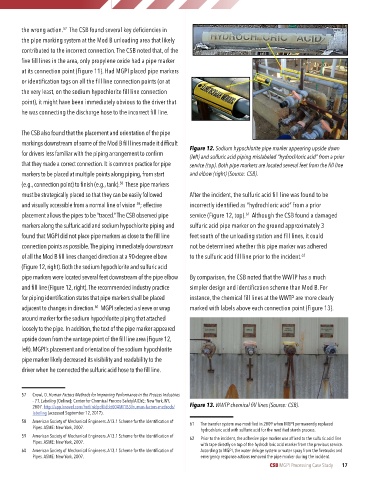
                                                                Figure 12. Sodium hypochlorite pipe marker appearing upside down
        for drivers less familiar with the piping arrangement to confirm
                                                                (left) and sulfuric acid piping mislabeled “hydrochloric acid” from a prior
        that they made a correct connection. It is common practice for pipe   service (top). Both pipe markers are located several feet from the fill line
        markers to be placed at multiple points along piping, from start   and elbow (right) (Source: CSB).

                                         58
        (e.g., connection point) to finish (e.g., tank).   These pipe markers
        must be strategically placed so that they can be easily followed   After the incident, the sulfuric acid fill line was found to be
                                              59
        and visually accessible from a normal line of vision  ; effective   incorrectly identified as “hydrochloric acid” from a prior
                                                                                  61
        placement allows the pipes to be “traced.” The CSB observed pipe   service (Figure 12, top).   Although the CSB found a damaged
        markers along the sulfuric acid and sodium hypochlorite piping and   sulfuric acid pipe marker on the ground approximately 3
        found that MGPI did not place pipe markers as close to the fill line   feet south of the unloading station and fill lines, it could
        connection points as possible. The piping immediately downstream   not be determined whether this pipe marker was adhered
        of all the Mod B fill lines changed direction at a 90-degree elbow   to the sulfuric acid fill line prior to the incident.
                                                                                                     62
        (Figure 12, right). Both the sodium hypochlorite and sulfuric acid

        pipe markers were located several feet downstream of the pipe elbow   By comparison, the CSB noted that the WWTP has a much
        and fill line (Figure 12, right). The recommended industry practice   simpler design and identification scheme than Mod B. For
        for piping identification states that pipe markers shall be placed   instance, the chemical fill lines at the WWTP are more clearly
                                60
        adjacent to changes in direction.   MGPI selected a sleeve or wrap   marked with labels above each connection point (Figure 13).
        around marker for the sodium hypochlorite piping that attached
        loosely to the pipe. In addition, the text of the pipe marker appeared
        upside down from the vantage point of the fill line area (Figure 12,

        left). MGPI’s placement and orientation of the sodium hypochlorite
        pipe marker likely decreased its visibility and readability to the
        driver when he connected the sulfuric acid hose to the fill line.


        57   Crowl, D. Human Factors Methods for Improving Performance in the Process Industries
            - 11. Labeling [Online]; Center for Chemical Process Safety/AIChE: New York, NY,
            2007. http://app.knovel.com/hotlink/pdf/id:kt004MI1B3/human-factors-methods/  Figure 13. WWTP chemical fill lines (Source: CSB).
            labeling (accessed September 12, 2017).
        58   American Society of Mechanical Engineers. A13.1 Scheme for the Identification of   61   The transfer system was modified in 2009 when MGPI permanently replaced
            Pipes. ASME: New York, 2007.
                                                                   hydrochloric acid with sulfuric acid for the modified starch process.
        59   American Society of Mechanical Engineers. A13.1 Scheme for the Identification of   62   Prior to the incident, the adhesive pipe marker was affixed to the sulfuric acid line
            Pipes. ASME: New York, 2007.
                                                                   with tape directly on top of the hydrochloric acid marker from the previous service.
        60   American Society of Mechanical Engineers. A13.1 Scheme for the Identification of   According to MGPI, the water deluge system or water spray from the firetrucks and
            Pipes. ASME: New York, 2007.                           emergency response actions removed the pipe marker during the incident.
                                                                                          CSB MGPI Processing Case Study   17

