


Page 40 - MGPI_Case_Study
P. 40
8.2.2   SHARED RESPONSIBILITY
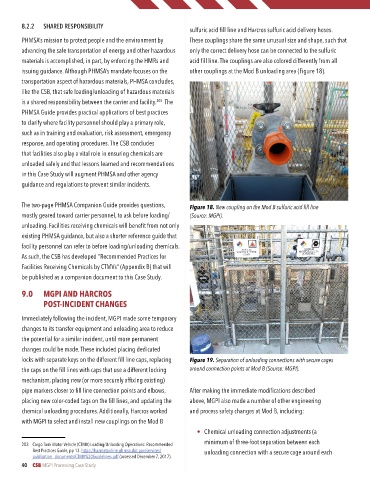
                                                                sulfuric acid fill line and Harcros sulfuric acid delivery hoses.
        PHMSA’s mission to protect people and the environment by   These couplings share the same unusual size and shape, such that
        advancing the safe transportation of energy and other hazardous   only the correct delivery hose can be connected to the sulfuric
        materials is accomplished, in part, by enforcing the HMRs and   acid fill line. The couplings are also colored differently from all
        issuing guidance. Although PHMSA’s mandate focuses on the   other couplings at the Mod B unloading area (Figure 18).
        transportation aspect of hazardous materials, PHMSA concludes,
        like the CSB, that safe loading/unloading of hazardous materials
                                                     203
        is a shared responsibility between the carrier and facility.   The
        PHMSA Guide provides practical applications of best practices
        to clarify where facility personnel should play a primary role,
        such as in training and evaluation, risk assessment, emergency
        response, and operating procedures. The CSB concludes
        that facilities also play a vital role in ensuring chemicals are
        unloaded safely and that lessons learned and recommendations
        in this Case Study will augment PHMSA and other agency

        guidance and regulations to prevent similar incidents.


        The two-page PHMSA Companion Guide provides questions,   Figure 18. New coupling on the Mod B sulfuric acid fill line
        mostly geared toward carrier personnel, to ask before loading/  (Source: MGPI).
        unloading. Facilities receiving chemicals will benefit from not only
        existing PHMSA guidance, but also a shorter reference guide that
        facility personnel can refer to before loading/unloading chemicals.
        As such, the CSB has developed “Recommended Practices for
        Facilities Receiving Chemicals by CTMVs” (Appendix B) that will

        be published as a companion document to this Case Study.

        9.0      MGPI AND HARCROS
               POST-INCIDENT CHANGES

        Immediately following the incident, MGPI made some temporary
        changes to its transfer equipment and unloading area to reduce
        the potential for a similar incident, until more permanent

        changes could be made. These included placing dedicated
        locks with separate keys on the different fill line caps, replacing   Figure 19. Separation of unloading connections with secure cages
        the caps on the fill lines with caps that use a different locking   around connection points at Mod B (Source: MGPI).
        mechanism, placing new (or more securely affixing existing)
        pipe markers closer to fill line connection points and elbows,   After making the immediate modifications described
        placing new color-coded tags on the fill lines, and updating the   above, MGPI also made a number of other engineering
        chemical unloading procedures. Additionally, Harcros worked   and process safety changes at Mod B, including:
        with MGPI to select and install new couplings on the Mod B
                                                                  •  Chemical unloading connection adjustments (a

                                                                     minimum of three-foot separation between each
        203  Cargo Tank Motor Vehicle (CTMV) Loading/Unloading Operations: Recommended
            Best Practices Guide, pp 13. https://hazmatonline.phmsa.dot.gov/services/  unloading connection with a secure cage around each
            publication_documents/CTMV%20Guidelines.pdf (accessed December 7, 2017).
        40  CSB MGPI Processing Case Study

